Author Archives: louiseturner

Writing Process Blog Hop

This is the first of two blog hops I’ve been tagged for today: to coin an old cliche, blog hops seem to be like buses – there are none for ages, then two turn up at once!

I’ll begin by saying a big ‘thank you!’ to Scottish historical fiction writer Marie MacPherson (author of The First Blast of the Trumpet, published by Knox Robinson Publishing) for tagging me.  If you haven’t already done so, go and read her book, because it’s great. As an added bonus, it’s full of Hepburns (Patrick Hepburn, 1st Earl of Bothwell, would be very proud of her indeed).  You can find out more about at:-   http://mariemacpherson.wordpress.com/2013/04/13/the-first-blast-of-the-trumpet/

1)      What am I working on?

I’ve recently finished the final edit of my second novel (Working Title: The Gryphon At Bay).  The sequel to Fire & Sword, it runs almost directly on from the ending of its predecessor. It turns the spotlight onto the character who was very much the anti-hero of Fire & Sword: Hugh, 2nd Lord Montgomerie.  This time around, Hugh finds himself in a difficult situation when he oversteps the mark by taking out one rival too many!

2)      How does my work differ from others of its genre? 

I like to think that my work is distinctive because it sees history as a series of interweaving events generated almost by accident. ‘History’ comes about through the actions of various individuals who all follow their own agendas and are moved by broader loyalties which may include political or family allegiance.  In that respect, I don’t have ‘goodies’ and ‘baddies,’ because everything depends very much on the perspective of the individual who’s at the heart of the story.

A lot of the time, I get frustrated by historical novels driven along by narratives that give the impression that history is somehow pre-determined.  It’s how individuals interacted with one another in the past that collectively generates what we see in the historical record, and this is something I try very hard to capture in my own work.  I can’t say this approach is truly unique – I remember stumbling across a historical novel way back in 2004 which I avidly devoured because it encapsulated exactly that kind of fluid, constantly renegotiated past which I was trying so hard to capture within my own writing. The book in question was A Place of Greater Safety, and the novelist Hilary Mantel. A Place of Greater Safety remains my favourite historical novel, and quite possibly my all-time favourite work of fiction – full stop.

3)         Why do I write what I do? 

I’m fascinated by people, in all their complexity.  I’m fascinated by their achievements and fascinated by the evils that they are undoubtedly capable of.  I studied archaeology because I thought it might inspire me as a writer of science fiction – the jump to historical fiction was unexpected, but perhaps inevitable, because the more I learned about Scotland’s rich and complex past, the more I felt there was an opportunity to increase its popularity amongst a wider audience.

This is something which I think is especially true for the West of Scotland – so often, there’s a belief that ‘History’ is something which took place somewhere else, usually around Stirling, or Edinburgh. But there’s so much more to Scottish History than the Wars of Independence and Mary Queen of Scots, though it seems sometimes as if those periods are almost endlessly revisited while others, equally fascinating, are virtually ignored.

I want to follow less well-trodden paths and acquaint myself with more obscure figures  – I find it more interesting when the gaps between the facts are more extensive and require more of a creative leap on the part of the author.

4)            How does my writing process work?

Creating believable characters is the most important part of my work.  With Fire & Sword, I made an in-depth study of the various individuals at the heart of the novel: John Sempill of Ellestoun; Hugh, 2nd Lord Montgomerie; Margaret Colville; Matthew Stewart, Master of Lennox; Helen Campbell, and the rest.  I acquainted myself with their biographies, I worked out who they married, who their close relatives were.  This allowed me to map family – and therefore political – allegiances in detail.  I noted certain facts about their family life – John Sempill appears to have been the only son in a family of five, while Hugh Montgomerie inherited his titles at the age of 12 from his great-grandfather. Little details like that informed upon the characters, helping to build them in my mind.

With the characters formulated, all that remained was to chart their actions and interactions throughout time and space. I rigidly keep to the facts as best I can when they are known (and I’m dealing with a very poorly documented period) and I gather together these facts by scouring the local historical accounts and also the secondary sources for any references to any of my characters so that I can weave a believable narrative which accounts for these facts.

It’s a very complex process, but it’s very fulfilling, too: these days I usually find it quite easy to convince my cast members to behave as expected and as a result, they independently re-create history as it actually happened!  I never consider the process of researching to be over, which means, of course, that there are always times when I stumble across a Little Known Fact Lurking in some obscure source somewhere which can rattle my expectations and assumptions. So far (touch wood!), I’ve been able to work my way round all these nasty surprises.

And now it’s my very great pleasure to hand on the metaphorical baton to my next three authors – Gillian Pollack, Judi Sutherland, and Juliet Waldron – whom you can find out more about below.

Gillian Polack is a writer, editor, historian and critic. She has taught creative writing and history at the ANU, at various Writers’ Centres and to members of other  professional writers’ organisations.  Gillian’s second novel Ms Cellophane was recently published by Momentum and was shortlisted for a Ditmar. She has edited two anthologies and has seventeen short stories published. One of her stories won a Victorian Ministry of the Arts award and three more have been listed as recommended reading in the international lists of world’s best fantasy and science fiction short stories. You can find out more about her at  http://momentumbooks.com.au/books/ms-cellophane/    or follow her blog at http://gillpolack.livejournal.com/

Judi Sutherland took a gap year after redundancy from the pharmaceutical industry, and studied for an MA in Poetry at Royal Holloway, University of London. Since then she has written the first draft of a novel and quite a lot of poems. She has taught Poetry to the Petrifed in Newbury, Berkshire and will be the Poet in Residence at the Ampthill Literary Festival in July. Her blog is at www.judisutherland.com.

Juliet Waldron has lived in many US states, in the UK and the West Indies. She earned a B. A. in English, but has worked at jobs ranging from artist’s model to brokerage. Thirty years ago, after her sons left home, she dropped out of 9-5 and began to write, hoping to create a genuine time travel experience for her readers. She’s a grandmother, a cat person, and a dedicated student of history and archeology. To find out more, visit her website at  http://www.julietwaldron.com


Paisley Author Event – 5th April 2014

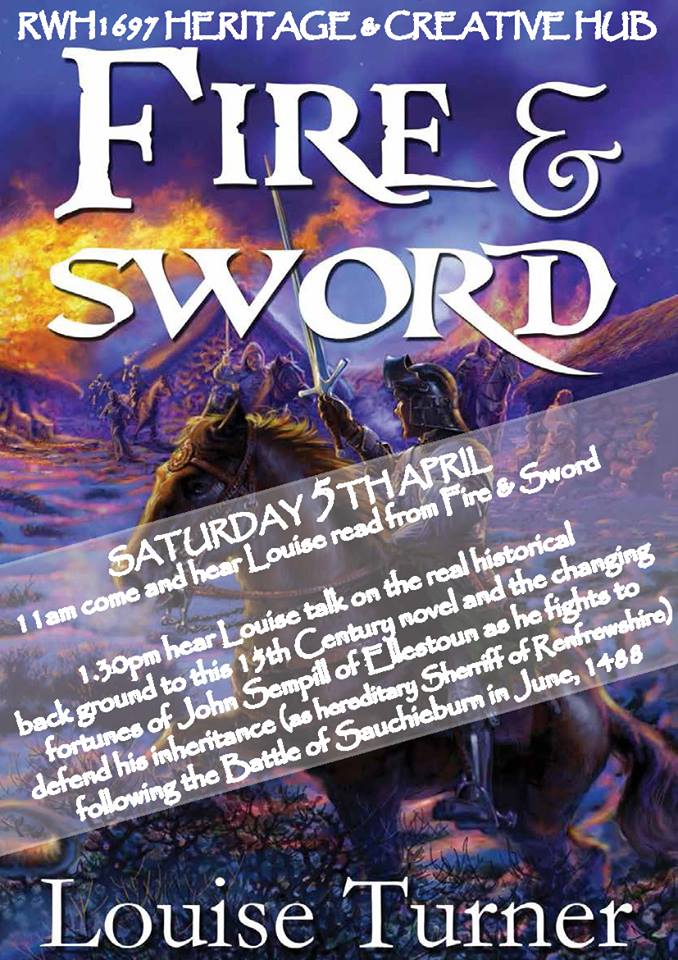
I’ll be attending not one but two author events this coming weekend (Saturday 5th April) at the Renfrewshire Witch Hunt 1697 Heritage & Creative Hub (located on the ground floor of the Paisley Centre).

At 11am, I’ll have my novelist’s hat on for an author event where I’ll be reading excerpts from the book.

And in the afternoon (1.30pm), I’ll be back, cunningly disguised as an archaeologist, for an illustrated lecture on the historical events which form the basis for the novel.  With a particular emphasis on Paisley, of course, which was made a burgh not long into James IV’s reign, thanks to the efforts of Abbot George Schaw (of Paisley Abbey) who appears to have acquitted himself rather well during the Battle of Sauchieburn in June 1488.

Paisley Flyer 2014

To find out more, and to enjoy some more tales (factual and fictional) of late 15th century mayhem, please come along!  Copies of Fire and Sword will be available to purchase on the day, courtesy of the RWH 1697 Hub and local Paisley bookshop, Abbey Books.

Hope to see you there!


Beith Book Signing

Last night, I had the pleasure of presenting a lecture to Beith Cultural & Heritage Society on ‘The Lords of the Westland’: Some Ayrshire Families & The Rise of James the Third’. It considered the real historical events that are recreated in ‘Fire and Sword’, and looked at some of the individuals who feature in the novel, with John Sempill of Ellestoun and Hugh, 2nd Lord Montgomerie studied in particular detail. When the lecture was over, there followed a lively question-and-answer session on how fact had been transformed into fiction in the process of creating the book.

I had a lovely time there.  My hosts were extremely welcoming, and while I didn’t shift many books, I signed a few that had been bought previously, which was very gratifying!  It was a real pleasure to chat with future readers who were looking forward to getting into the novel, and who’d enjoyed this opportunity to get the facts presented to them before they embarked on the fictional version of the story.

I was also delighted to meet up with Ann McMillan, Honorary President of the Dorothy Dunnett Society, who’d travelled all the way up from South Ayrshire for the occasion.  A signed copy of Fire and Sword was purchased there on behalf of the Society – which is destined to be given out as a raffle prize at their annual dinner!  To receive this news is – as you may imagine – quite an honour!!

My next appearance will be on the 5th April in Paisley, where a veritable extravaganza of ‘Fire and Sword’-related activities will be taking place, including readings in the morning and a lecture in the afternoon.  There will, of course, be a particular focus on Paisley and its abbey – the abbot at the time, George Shaw, was deeply embroiled in the coup and even fought at Sauchieburn for James IV.  For more information concerning dates, venues, etc. watch this space!!

In the meantime, copies of the book can be purchased locally at Abbey Books in Paisley, Beith Town Hall, Beith, and the Renfrewshire Witch Hunt 1697 Hub in the Paisley Centre, Paisley.

BCAHS 2014

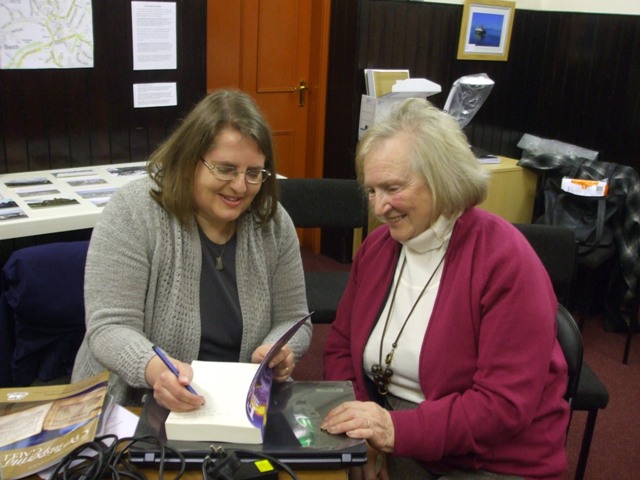
The author with Ann McMillan, Honorary Present of the Dorothy Dunnett Society


Progress Report…

I’m delighted to announce that I’ve finally finished editing my second novel (working title ‘The Gryphon at Bay’) to a level where I’m now happy to send it out to my publishers.  Set immediately after the events in ‘Fire & Sword’, it turns the spotlight onto the incorrigible Hugh, 2nd Lord Montgomerie: I suppose, if I was to summarise it succinctly, I’d say it was a novel about hubris, & about the changing whims of Fortune.

I’ll leave things at that just now, I think.  So far, ‘Fire & Sword’ has earned 6 5-star reviews on Amazon (3 5-star reviews from each side of the Atlantic): to receive such positive feedback from readers gives real encouragement to a writer, providing us with just the impetus we need to keep on working hard to complete novels and get them out into wider circulation.

Unfortunately, I can’t give you any idea of if and when ‘The Gryphon At Bay’ (if indeed, that remains its title) will be approaching publication as my editor & publisher at Hadley Rille Books, Eric Reynolds, has been taken ill and it’s not likely he’ll be back at his desk any time soon.

Eric’s been a solid and enthusiastic supporter of my work, and without his decision to publish ‘Fire & Sword’, I don’t think I’d be here now celebrating the completion of my second novel, which only took a mere 9 years to finish!  So it seemed obvious to me as I added the finishing touches to the MS that ‘Gryphon’ should be dedicated to him.

With this major project completed, I’ll be taking my foot off the gas for a while and concentrating on trying to widen public awareness for ‘Fire & Sword’ both in Scotland and further afield.  I’ll also be getting on with my third novel, which is a wee bit different from what’s gone before, I must say, as well as starting the long process of researching novel #4, which will be the next installment of my late 15th century series – let’s call it ‘The Westland Chronicles’ for the time being, though this isn’t exactly official right now!

I have some vague ideas as to what will happen next in the story arc, because I’ve read the historical accounts.  But how these vague hints eventually transform themselves into a narrative will be as much of a surprise to me as they will, hopefully, be to you, and the process of this transformation will, I hope, be great fun to be involved with!


Stop Press (And A Happy New Year to Y’All!!!)

American readers may be interested to know that Amazon is currently (as of today!) selling ‘Fire and Sword’ for the eye-wateringly low price of $3.52.  This is for a paperback edition, not a kindle/e-book.

So what are you waiting for?  454 pages for $3.52?!?!  And the book’s already had 3 5-star reviews on Amazon UK and 1 5-star review in the US.

There.  That’s my sales pitch for the day.  Check out the link below if you’re interested.

http://www.amazon.com/Fire-Sword-Louise-Turner/dp/0989263134/ref=sr_1_1?s=books&ie=UTF8&qid=1388952320&sr=1-1&keywords=fire+and+sword+turner

And have a great 2014!!!  Apologies if I’ve been quiet the last couple of months, but I’m embroiled in the editing of Book 2 and it’s taking up most of my time these days.  My sincere thanks to those of you who supported me in 2013 by either buying the book or posting a review.  I’m just hoping that 2013 will be half as exciting for me as 2014 turned out to be!!

To North Ayrshire, & Beyond!!!

I’ve been beavering away the last few months getting ‘Fire & Sword’ out to an ever-wider audience, and it looks like all the hard work is paying off at last!!

First of all, can I remind you of the forthcoming signing at Abbey Books ( Well Street, Paisley) on 14th December, 1.15-3.15pm.  Posters are appearing at various venues around the town, so keep an eye open for them!  And a big ‘thank you’, to all those who have helped out by displaying them, including The Wynd cafe and The Grumpy Monkey cafe, as well the Paisley Arts Centre, Paisley Library and Paisley Museum.

Staff at the gift shop at Paisley Abbey have also taken a poster and long term may even be stocking the book itself – watch this space for further details, if and when it happens.

Last but by no means least, copies of ‘Fire and Sword’ will be available at the Beith Cultural and Historical Society Christmas Fair, which is great, because it means that I’ll be venturing forth into North Ayrshire.  North Ayrshire is of course Montgomerie country, and if you don’t know the connection between the Montgomeries and ‘Fire and Sword’, you either haven’t been paying attention, or you need to get out there and read the book!


Happy Birthday, Hadley Rille Books!

For a few days each year, my publishers – Hadley Rille Books – celebrate their anniversary with a massive sale on e-books, titles on kindle and nook, and also savings on their print editions, too.

So if you enjoyed reading ‘Fire and Sword’ and you fancy trying some of their other titles, now’s the time to take a good look and pick out some likely candidates.  With Christmas fast approaching, isn’t it about time you got some reading matter together?  That’s what holidays are for, after all – that is, if you’re not madly writing to hit the submission deadline (self-imposed!) for your novel…

So if you’re a fan of science fiction, fantasy or historical fiction, check out the link below and see what takes your fancy:-

http://www.hrbpress.com/

And hurry!  You’ve only got until Saturday….

Scottish Book Week

Sometimes it feels very strange, being a Scottish writer based in Scotland who writes historical fiction set in Scotland but who just so happens to be signed up with a US publisher (Phew!  That was a mouthful, wasn’t it?).  The Scottish literary scene is very active and busy, but when you find yourself on the fringes of it all, it can sometimes seem like you’re a mangy wolf skulking around while there’s a great big party going on inside the palisade.

But in the modern cut-throat world of publishing and book-trading, I like to think that all of us little guys are in this together, so if I can put in a plug for independent presses and booksellers, I’ll do it.

It’s Scottish Book week this week.  Across the country, there are events being held which celebrate Scottish writing and Scottish publishing, so if you find yourself looking for something to do between now and the 30th, check out the website at  http://www.scottishbooktrust.com/book-week-scotland  and see if there’s anything that takes your fancy.

And I’d also like to give a special mention to the pop-up bookshop in the Mitchell Library, Glasgow, which is being run by the Milngavie Bookshop.  If you’re passing by the Mitchell this week, pop in and take a look – my personal favourite amongst the new titles has to be ‘Look Up Glasgow’, by Adrian Searle and David Barbour.  It’s definitely one of those ‘gosh, I wish I’d thought of that first’ kind of books – it takes a look at some of Glasgow’s architectural gems which though located across the city remain largely hidden and unappreciated because most visitors only interact with the buildings at eye (or shop front) level.

Those of us who do take the time to look up and see the ‘angels in the architecture’ (as Paul Simon would say) aren’t remotely surprised that the authors have found enough information to fill a book devoted to the subject.  But I think most of us would be hard-pressed to be able to capture the wealth of images that graces the pages of ‘Look Up Glasgow’ – it’s a truly stunning tribute to the city and its architectural treasures.

Incidentally, the Milngavie Bookshop – as well as stocking an excellent range of up-to-date titles – has a lovely little cafe attached with some excellent soups and cakes.  So if you ever find yourselves in or around Milngavie, please check them out (more info as http://www.milngaviebookshop.co.uk/).

And if you need an excuse to go and visit Milngavie, can I just point out that it’s just a stone’s throw from the Campsies (in the lands of the Lennox, John Stewart’s stamping ground, if you know your ‘Fire and Sword’) and that there are some really nice walks around Mugdock Country Park.  There’s a ruined castle there, too, but that’s another story!!


I’m delighted to announce that I’ll be signing copies of ‘Fire and Sword’ at Abbey Books in Paisley between 1.15 and 3.15pm on Saturday 14th December, so if you’d like to come along to say ‘hello’, then it’d be lovely to see you!

Copies of the novel will soon be available to purchase from Abbey Books, so if you’re interested in buying a copy, you can rest assured that you’re helping to support a local Paisley-based business at the same time!

[Psst – I haven’t even mentioned the fact that Abbey Books have a spectacular range of second books available in the shop.  When I called in on Saturday, I managed to pick up a copy of ‘The Letters of James IV 1505-1513’, which will be added to my primary research materials for future novels!]

Check out their website which can be viewed on the link below, and hopefully I’ll see you on the 14th!

http://abbeybookspaisley.co.uk/


Repaying Old Debts…

I dropped by Paisley Central Library yesterday, armed with a copy of ‘Fire and Sword’ which I’d brought along to donate to the library’s collections.

As I waited there in the queue, it felt like things had come full circle.  I was a regular attendee of the Paisley Writers’ Group for many years when it was based at the library.  I was in the early stages of writing the novel when I first joined them, and it was there that I really learned how to write:  I hung out with a number of talented local writers who weren’t afraid to offer an honest critique of my work, and much of the time we were mentored by professional writers-in-residence – Ajay Close and Paul Houghton were at the helm in the years I attended.

Numerous photocopied extracts of the novel were circulated for critique, and through that process I learned to edit.  And I learned, too, the advantages of carrying out a major slash-and-burn on the manuscript before it finally gets sent off to a publisher.  I don’t personally believe that pace is everything, and I don’t enjoy reading books that carry you along at a relentless breakneck gallop from beginning to end, but moving along at a brisk trot is helpful, and hearing the views of other writers certainly taught me to evaluate pace and pick up the speed as necessary.

Yes, a donated copy of a completed novel seems a small price to pay for the years I spent honing my craft there.

And on the subject of nostalgia (and this is really a long shot, I know!) I still owe a free copy of the book to a now-retired Conservation Officer attached to the Planning Department of Renfrewshire Council.  We once met up to discuss all things Semple-related when I was an impoverished out-of-work archaeologist: he very kindly bought me lunch, the arrangement being that I would pay him back by giving him a copy of the book once it was published.

Duncan, it’s been years, I know, but the arrangement still stands.  If you should stumble across this post, then please get in touch so I can get you your signed copy, would you?