On Tour In – The South Rhins of Galloway

A good few years ago, I used to write a regular blog on Live Journal, under the pseudonym ‘Endless Rarities.’

It was biased towards archaeology and heritage much of the time, because these things play such an important part in my life. And I got a lot of interest in my holiday-related posts, because they invariably veered towards All Things Archaeological and Historic Building Related, and quite often they stepped a wee bit off the beaten track.

In the intervening years, there’s been a move towards short videos and vlogs and the like, but I have no desire to yatter on at length into a camera lens. I like words. So I’ll keep writing words, and if you’re reading this blog, no doubt you like words, too, so I guess we’re evenly matched.

So, new place, same principle. Though with less images, sadly. I had to sift through all my photos and select the one image that I felt encapsulated the whoie trip – explanation below!

Just as I’m a fan of ‘slow publishing,’ so I’m a fan of ‘slow holidays.’ To quote the inimitable Guy Garvey of Elbow, ‘Just pick a point and go.’ (a line from Loneliness of the Tower Crane Driver – if you don’t know it, go check it out!) And when you get there, stay there. Wander round, examine the area with an almost forensic intensity. Get to know the landscape, the geology, the wildlife, the history, the archaeology, the built heritage.

Our ‘slow holidays’ are probably the antithesis of an ocean cruise. I don’t think I could bear an expedition that covered a vast distance but took in its destinations via a couple of bite-sized chunks. It’s just not for me. A couple of years ago, we had a flavour of something similar when we went on a marathon (sorry!) archaeological tour of Greece. It involved travelling from Athens, all the way round the Peloponnese, up to Macedonia and back over 13 days, taking in Nafplio, Mycenae, Sparta, Olympia, Delphi, Meteora and so many other interesting locations. It was a great experience, but it had the vibe of a university fieldtrip on speed. I was left feeling shattered and also slightly frustrated because we never got to know any one place properly. I did want to return to several towns for a much slower visit, so maybe that’s a victory for the Greek Tourist Board…

The Greek Odyssey was an exception. Most of the time, we follow the Guy Garvey advice. There are two prerequisites which drive our choice of destination. Firstly, there must be good walking. Coastal trails, hill walks, town walks, whatever – each has their merits. Secondly, there has to be a particular site of interest to target nearby. It could be a castle, a cathedral, a historic town. Or something prehistoric, like a hillfort, some kind of cairn, whatever. I’m very cosmopolitan in my interests.

Staying in the South Rhins of Galloway was kind of tricky because it involved more driving than I’d hoped for. We both like to dump the car for a week and walk most of the time, maybe drive a short distance. This time, it wasn’t really possible because I wanted to visit the Mull of Galloway (with lighthouse) and the nearest hotel (I don’t like self-catering, feel it doesn’t bring as much benefit to the local economy) was at Sandhead, miles away. Still, that was fairly close to my other target for the trip, which was really the main attraction, and something I’d had on my bucket list for years: the broch-like structure at Doon Castle, Ardwell Bay.

Anyway, as ever, we stumbled across much much more. In all, we got to check out the following interesting places:-

Day 1: Went for an evening walk to check out the village of Sandhead. Got a lovely view of Balgreggan Motte, a medieval motte re-used as a WWII observation post, which is just outside the village, We also got the merest glimpse (we think…) of some concrete targeting pillars of similar vintage in the bay nearby, If we’d had the chance to do the coastal walk north from Sandhead, we’d have had a better opportunity to check this out – ah, I think I feel a return trip coming on….

Day 2: Mull of Galloway lighthouse (1830, engineered by Robert Stevenson); Mull of Galloway promontory fort, comprising two rather weary and mucked about ramparts cutting off the neck of the Mull (Iron Age? Early Medieval? Possibly both….).

Day 3: Doon Castle broch, or broch-like structure, depending on the rigidity of your classification system (Iron Age, and looking rather resplendent after some consolidation work led by AOC Archaeology Ltd and assisted by local volunteers in 2024). There were salt pans at the other side of Ardwell Bay which would have been interesting, but we’d walked from Clachanmore which was quite a hoof.

The other aim of the day was to visit the Kirkmadrine Stones, which are a lovely collection of Early Medieval cross-incised stones housed at Kirkmadrine Church. The current church building is on a site which seems to have been a focus for Christian worship from a very early stage (?5th century AD or thereabouts, potentially even predating Whithorn).

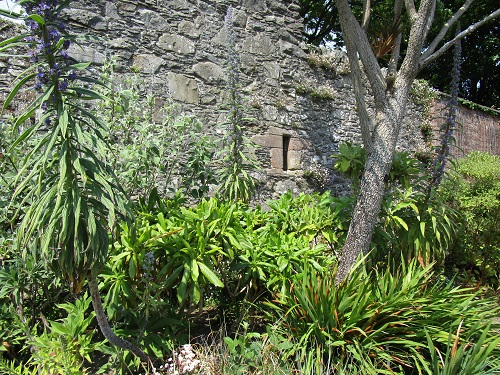
But before we got there, we added in a detour to the Logan Botanic Gardens for lunch, and there we stumbled across our Bonus Site – Castle Balzieland! It survives as a fragment of post-medieval tower-house, nestling within the boundary wall of a walled garden, where it’s obscured by giant lobelias and all sorts of other lovelies. When I first clapped eyes on it, I remarked to my hubby, ‘Is that what I think it is????’ After a bit of nosing around, when I’d clocked the speckled masonry and the all-important little rectangular window, I was certain, and it was at that point I checked the map. Bingo!!! Extra points scored for an unexpected tower-house! Finding it was one of the highlights of the holiday so it’s a view of that tiny little fragment of post-medieval walling that was selected for my featured image, surrounded by its obscuring horticultural exotica

And then it was off to Kirkmadrine to see those lovely stones….

Day 4 : Home time! But there was one last treat in store. I’d clocked a building in Sandhead that featured the legend ‘CCCS 1893.’ It looked industrial, so I’d spent the last day or so conjuring up the meaning behind the initials. I’d finally come up with ‘Cairnryan Creamery Co-operative Society.’ Its formal name, evidently, is The Old Creamery, Sandhead.

When I hopped out of the car in passing to take a photo, I started chatting with a friendly local resident, who informed me that yes, my guess was pretty much spot on. She then proceeded to talk me through the way in which the building had functioned when in use, with milk delivered at first floor level via a roadway at the rear. She also told me that the reason why a nearby street was called ‘Piggery Lane’ was because the surplus whey had been used to feed pigs at a piggery that once stood on the site. If you click the link above, it tells you all this and more – cynical friends of mine will no doubt tell me that if I bothered to use my phone, I could have found out all this myself, but I think my way’s much more fun!

Slow holidays – don’t you just love them! And that’s without mentioning all the other nice little factoids that accumulated throughout the trip. Like the discovery that the pretty little plants that didn’t quite look like scabious on the Mull were ‘goats milk vetch,’ which was a completely new one to me, and that black guillemots are called ‘tysties’ in Shetland….

Okay, there were some low points. Galloway is steadily losing its unique landscape character. The wonderful little stone-walled fields and humps of outcrop which form such a distinctive part of the countryside there are being progressively erased by large-scale industrial farming methods, and no-one can do anything to stop it. Fields are getting bigger and bigger, in a process I’ve heard described as ‘prairiefication,’ so-called because it leaves the undulating hills looking like miniature versions of the American prairies. The process is ongoing, so get to see the Rhins soon, before its original character is erased completely.

I only wish I hadn’t left it so long.
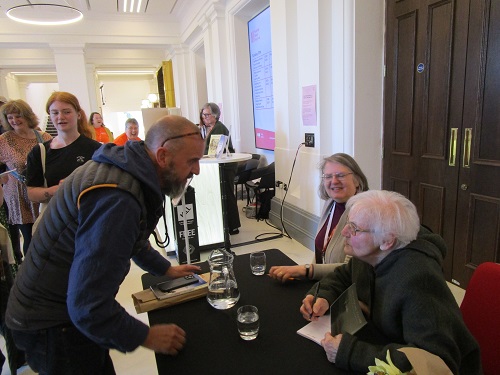
Bobby Motherwell with Betty McKellar and Louise Turner at the Signing

Betty McKellar at the Paisley Book Festival 2026

I had a fantastic day on Sunday 17th May at Paisley Book Festival 2026. I was there hosting an event showcasing the life and work of fellow Lochwinnoch Writer and celebrated poet, Betty McKellar.

Betty has earned the title of the ‘Bard of Lochwinnoch’ as a result of her fine poetry which seems to channel the spirit of not only the village itself but also the countryside around Castle Semple Loch and the Muirshiel Glen. The Sunday afternoon event in Paisley Town Hall was very well attended, and Betty regaled us with fine renditions of a selection of her poems, starting with Come Sit With Me (immortalised in stone at the Johnshill Viewpoint) and ending with Crannog Kind. Helping give Betty a well-earned rest along the way were a number of Lochwinnoch Writers, including Ross Anderson, George Colkitto, James Dunlop, Grace Houston, Michael Jarvis and Deborah Winters. They each read one or more of Betty’s poems, all selected from the newly-released retrospective collection Swan Songs, which was also launched at the event.

One of the nicest parts of the day was the opportunity to meet up with several members of the local writing community, some of whom are formidable poets and/or writers in their own right. Some were old friends, familar to Betty from her early days with Johnstone Writers. Spotted amongst the crowd (and the queue for the signings!) were Donna Bryson, Jim Carruth, Ian Hunter and Kay Metcalf – a big thank you to all of you for supporting the event and supporting Betty, too.

I think one of my favourite highlights of the day was seeing Betty connect with Renfrewshire-based poet Bobby Motherwell. Like Betty, Bobby finds inspiration in wildlife and the natural world and he was poet-in-residence at the RSPB Lochwinnoch for several years.

When I first watched Bobby perform at the Lochwinnoch Arts Festival a couple of years ago, he referred to Betty by name and even mentioned her in one of his poems. At the beginning of the year I made it my aim to get Betty and Bobby to connect somehow, so I think this photo (above) of Bobby Motherwell and Betty McKellar chatting at the signing, has to have been one of my favourite memories of the day.

Thanks to Paisley Book Festival 2026 for enabling the event and making it all run so smoothly, and thanks to everyone who attended.

Launching The Gryphon!

It’s been over a month since The Gryphon at Bay was launched at the Lochwinnoch Arts Festival – yes, I should have been writing this post long ago, but it’s been a very busy couple of weeks with work commitments and book commitments and all sorts of things cropping up!

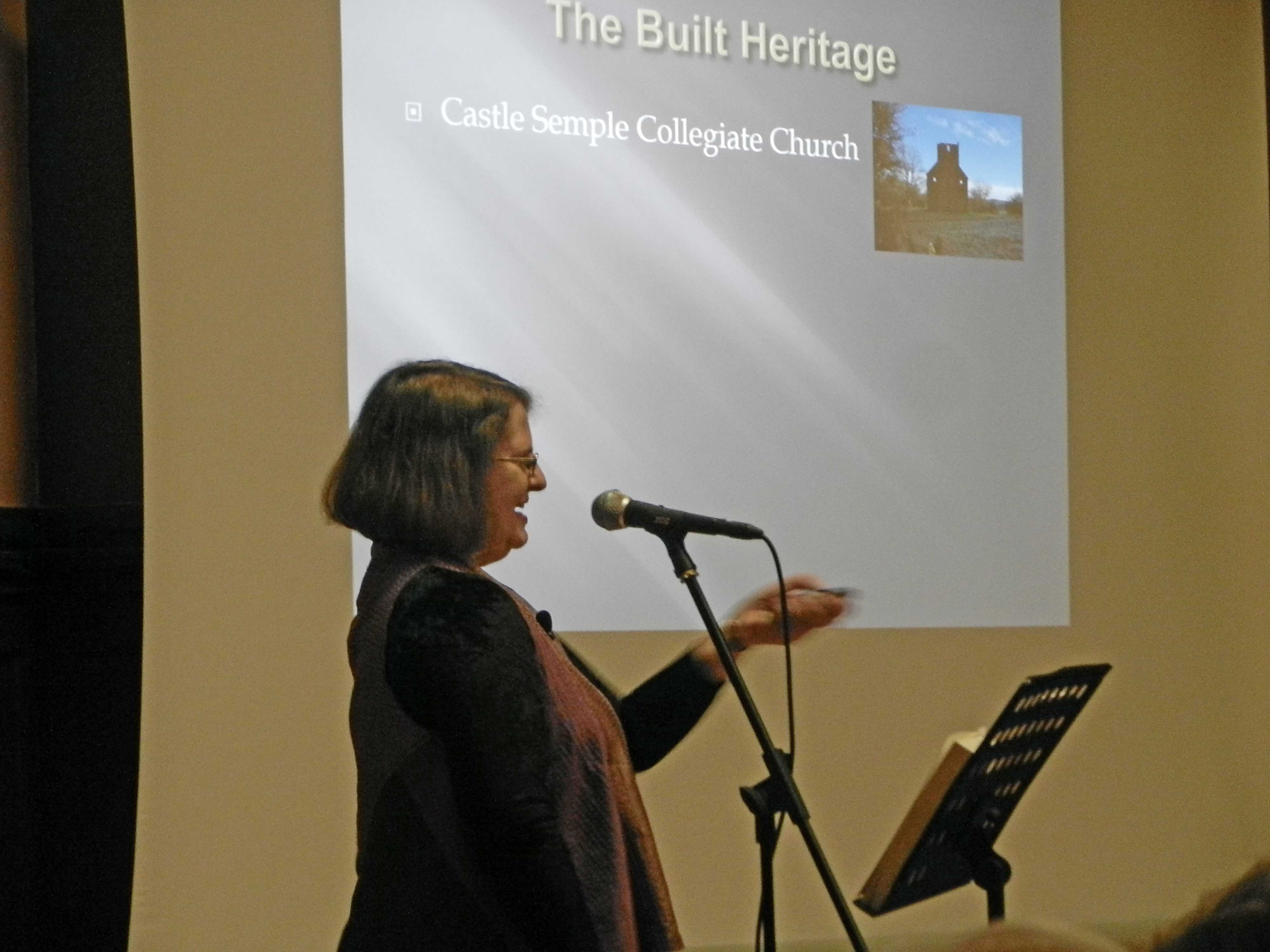
Launching Gryphon at the Lochwinnoch Arts Festival was wonderful – the organisers did a great job and everything ran very smoothly.  The evening kicked off with a short showcase of work from the Lochwinnoch Writers Group, after which I gave a short illustrated talk about the Sempill family and their connections with Lochwinnoch. The family resided at Castle Semple and/or Elliston castle throughout much of the medieval and post-medieval periods, so there was plenty to talk about in the 20 minutes allotted, including the siege of Castle Semple which took place in 1560, at around the time of Mary de Guise’s death.

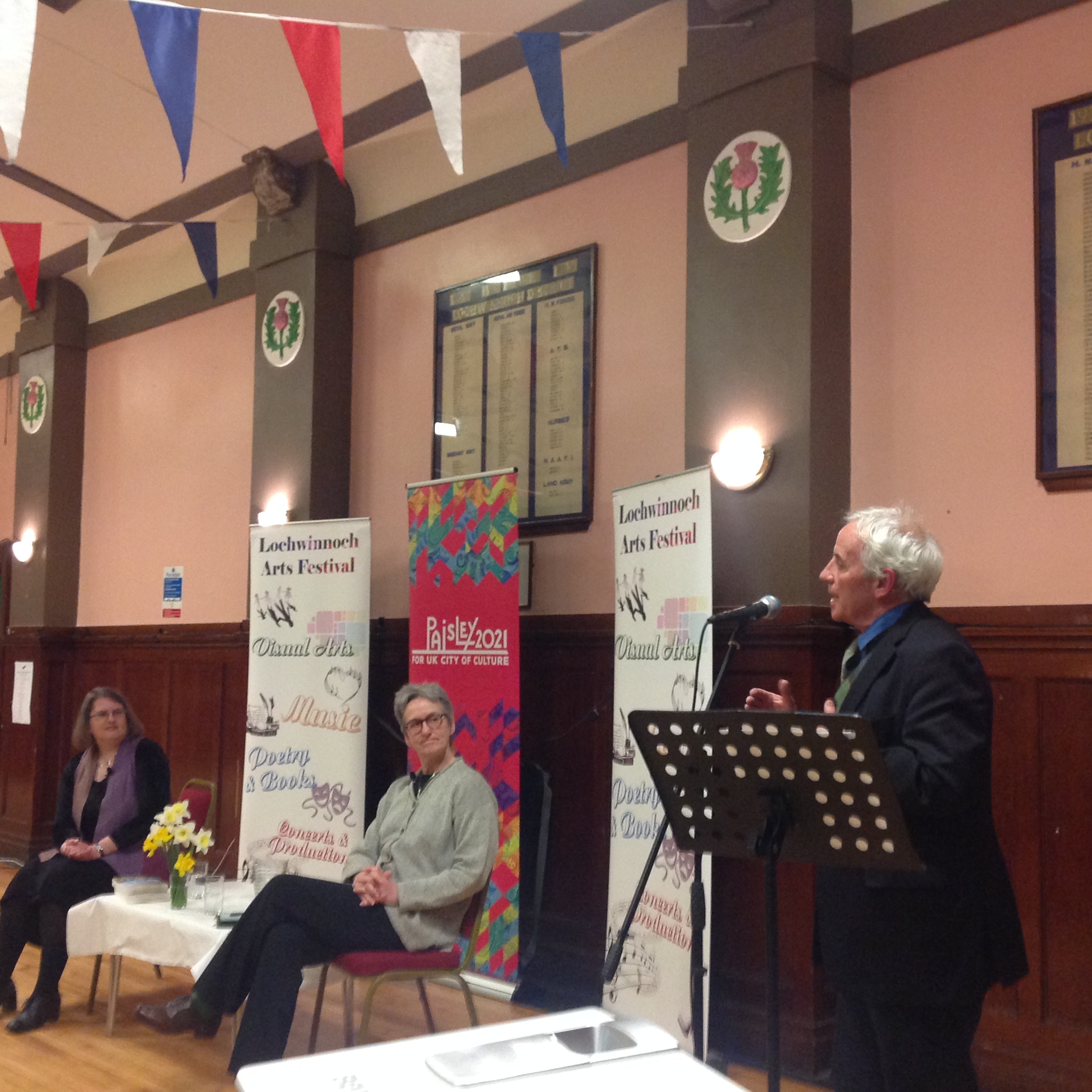
DSCN3282An interview and question and answer session followed, before the current Lord Sempill provided concluding remarks in which he talked both about the clan’s historic links with Lochwinnoch and how these links have been re-established in recent times. As an author who writes about the Sempill family as it was 500 years ago, I find it immensely satisfying to know that the living descendant of the individuals I write about and ‘know’ so well takes an interest in my work, and it was certainly an honour to have Lord Sempill there to help celebrate the launch.  The current owner of Elliston castle also attended the event, which was another welcome surprise!

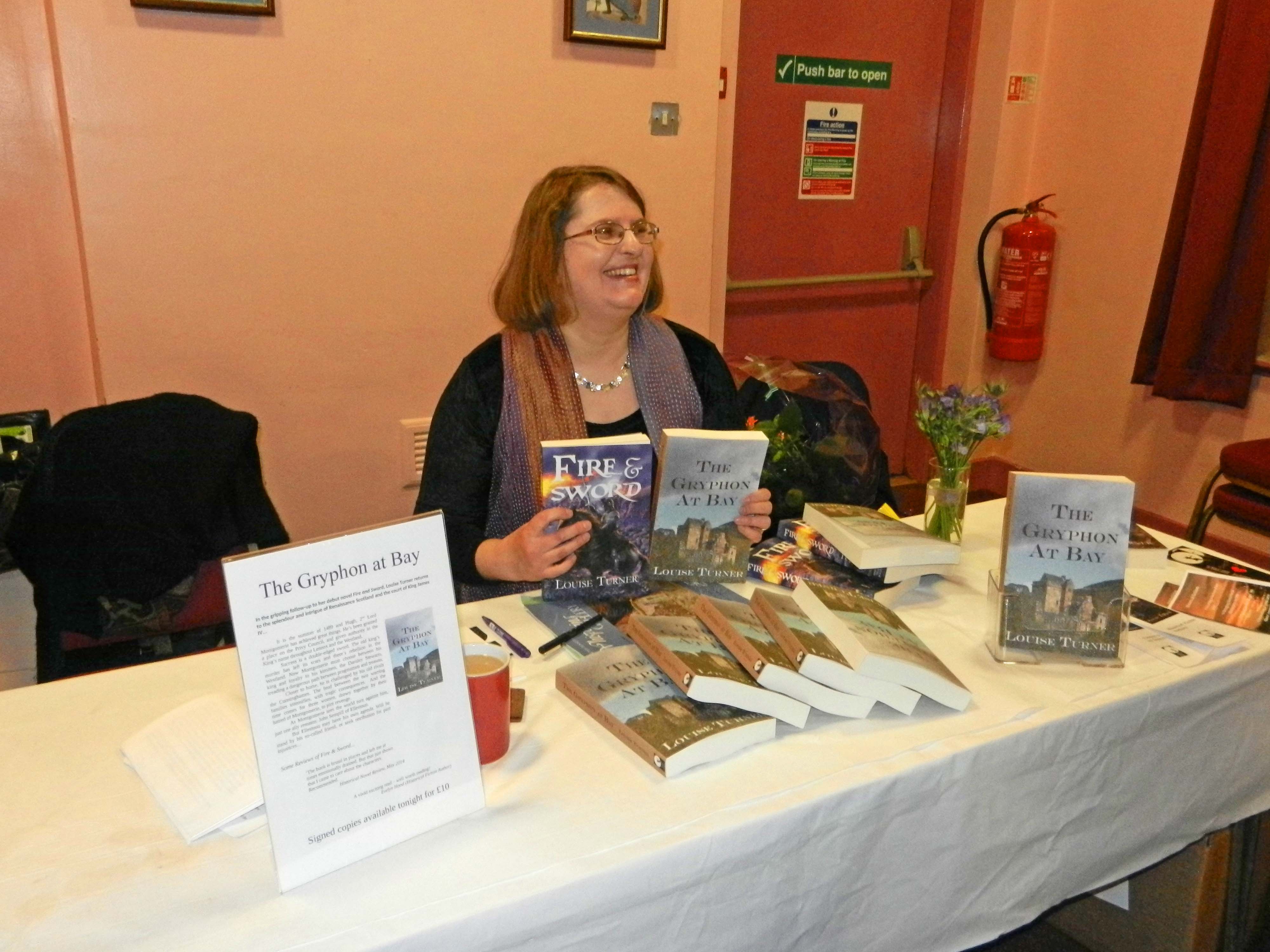
image(1)Altogether, it was a fabulous evening, and the event was very well-attended, too.  I’d like to extend my thanks to all those who turned up on the night, to the members of Lochwinnoch Writers Group who shared a variety of prose and poetry in the opening section, and – last but by no means least – to the organisers of the Festival who made it such a night to remember!

DSCN3298


And Now, A Special Announcement!

Well, after weeks spent beavering away at edits and the like, the follow-up to Fire & Sword is now ready for release!

It’s called The Gryphon at Bay, it features as its main character and (anti-!)hero the man everyone loves to hate from Fire & Sword: Hugh, 2nd Lord Montgomerie.

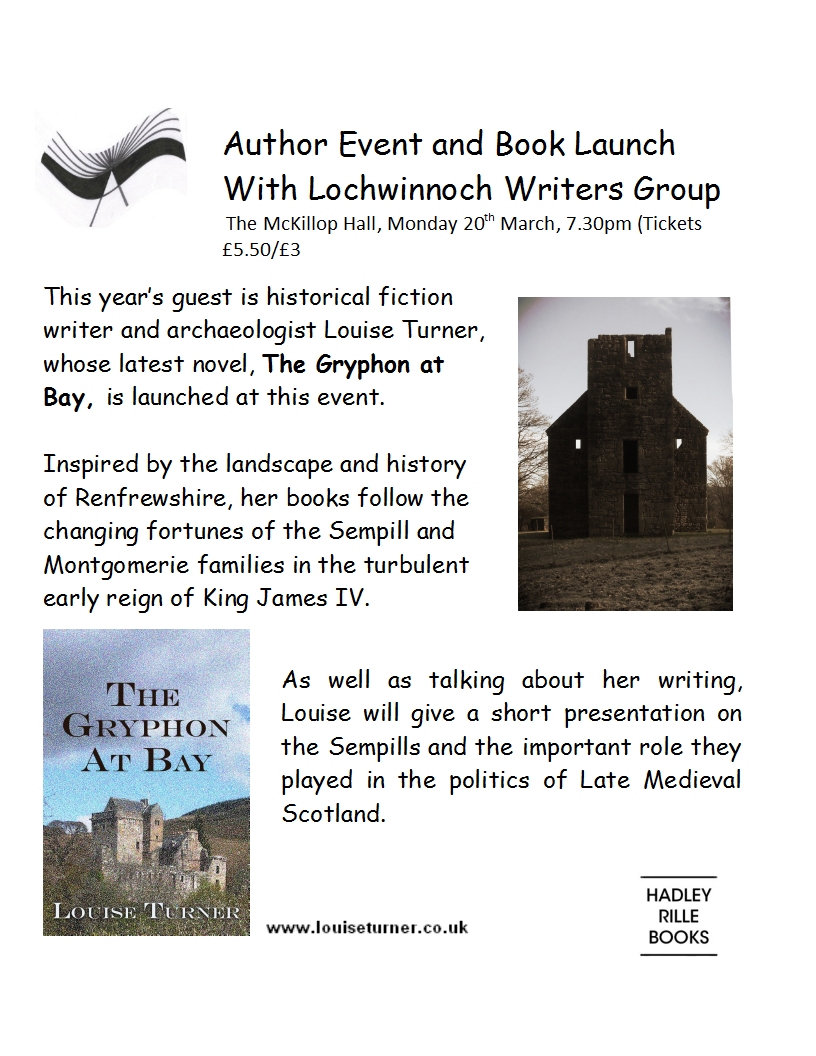
The launch will take place on Monday 20th March at 7.30pm in Lochwinnoch: full details are shown in the accompanying flyer!

Flyer 2017

It’s shaping up to be a great night – tickets are available at outlets around Lochwinnoch, and they’ll also be available at the door.  And, of course, you’ll be able to get your signed copy of the book and find out what happens next in the saga of John Sempill of Ellestoun, Hugh, 2nd Lord Montgomerie, Margaret Colville, Helen Campbell and Matthew Stewart, Master of Lennox!

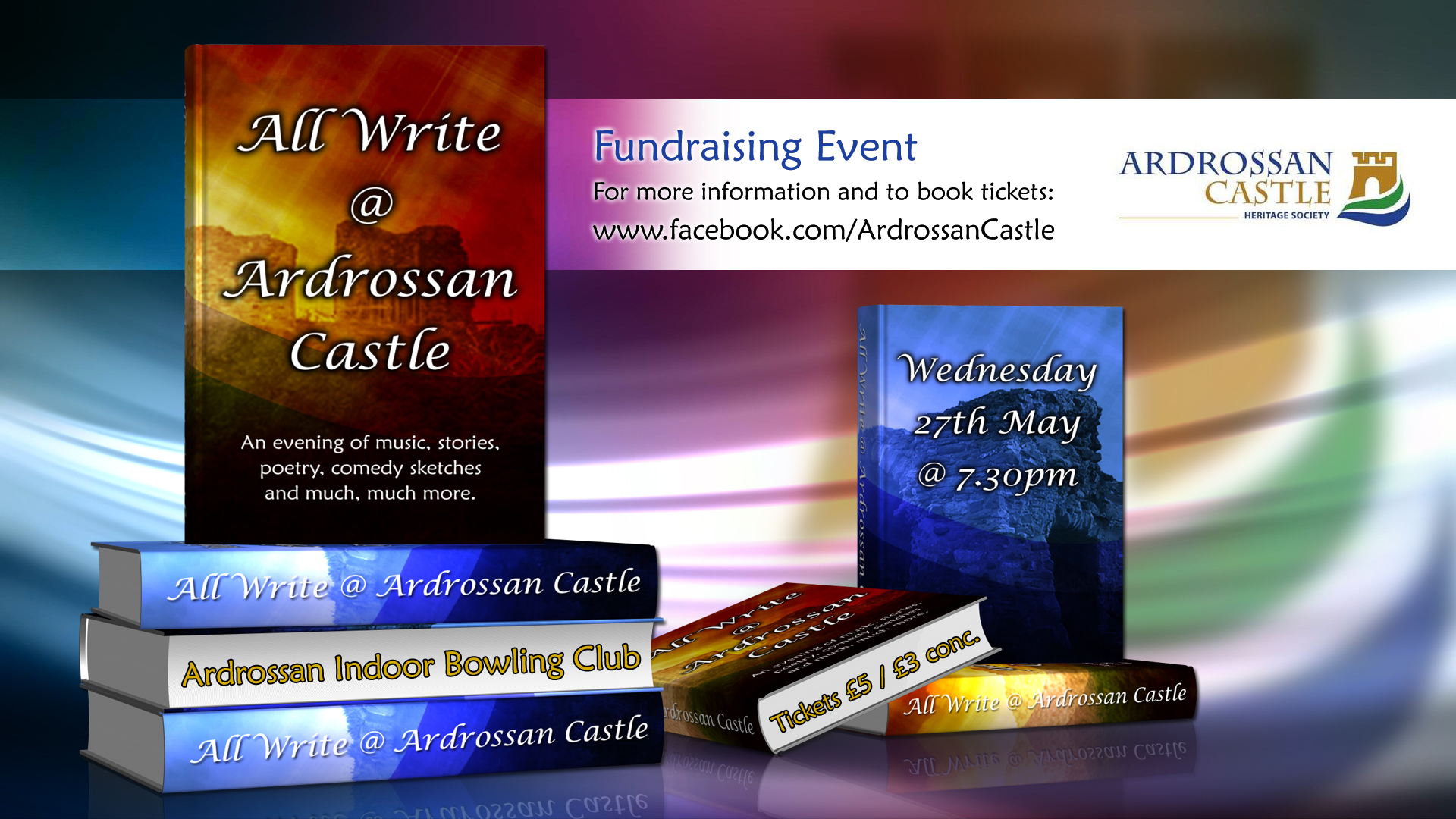
All Write @ Ardrossan Castle!

If you’re anywhere near Ardrossan on Wednesday 27th May, at 7.30pm, then why not drop by the Ardrossan Indoor Bowling Club for an evening of poetry, literature and music, in aid of the Ardrossan Castle Heritage Society.

I’ll be reading from Fire & Sword, but if that’s not enough to whet your appetite, I’ll be joined by Margaret Skea, who will be reading an extract from her prize-winning novel Turn of the Tide, published by Capercaillie Books, which also has the Montgomerie-Cunninghame feud at its heart (though it’s set a whole hundred years after the events in Fire & Sword).  And we’ll be joined by Evelyn Hood, who will be appeared as a special guest for the occasion.

There will be poetry from the Bard of Lochwinnoch, Betty McKellar, and some comedy sketches from Skelph (an offshoot of the Largs Writers Group), plus performances from a Gaelic Choir.

Refreshments and snacks will be available on the night, and tickets cost £5 (£3 concession) and are available at the door.  Hope to see you there!

ACHS-All-Write-Promo


‘My Lovely Blog’ Blog Hop…

I’ve been tagged by author Tim Taylor ( you can check out his blog at http://www.tetaylor.co.uk/#!blog/c1pz) as a participant in the ‘My Lovely Blog’ blog hop.  It’s been quite a challenge, as its parameters have been so broad and its subject matter so wide-ranging, but here are my replies!

First Memory

I think my first memory is of being given a teddy bear as a present by my grandparents. I was very, very young at the time, just a baby, but I can remember the bear, very clearly – it was a small creature with strange colouring which is (with the benefit of hindsight and accumulated wisdom) the same colour as a Siamese chocolate-point cat. Though the creature in question is most definitely a bear, and not a cat…

And if this particular memory must be dismissed as half-imagined, what I do distinctly remember is the day when – as a toddler – I got a real telling off from my mum because I’d spread solid perfume all over the back of her lovely walnut dressing table. What’s odd is that I can actually remember being baffled because I couldn’t understand what she was getting so upset about – I only did it to make the furniture smell nice.

Books

Like many children of my generation, I learned to read on a combination of Ladybird titles, Topsy and Tim and the Beatrix Potter books. The first book I remember really, really wanting to acquire was Tumble: The Story of a Mustang (the title’s the only thing I remember) which was given to me in my the early days of my primary school career.

Throughout primary school, my life was enriched by a diet of pony books and children’s historical fiction, with some science fiction thrown in as added seasoning. Outstanding books of this time were The Eagle of The Ninth by Rosemary Sutcliffe, and the Jinny series by Patricia Leitch, in particular the haunting and terrifying (but archaeologically suspect, though let’s not go there….) The Night of the Red Horse. I remember growing up wanting to be just like Jinny, and wishing fervently that I could have a chestnut arab soul-mate like Shantih.

Just a couple of years ago, I re-read the Jinny books, and discovered to my horror that not only had my writing style been influenced by Patricia Leitch’s work, but I had grown into someone sufficiently like Jinny to cringe at the resonances. Except that my soul-mate wasn’t a chestnut Arab mare called Shantih – it was a chestnut hackney Connemara cross gelding named Squire Thomas….

I digress… In my early teens, I started reading science fiction and fantasy. The Narnia books and Susan Cooper soon flowed into Tolkein, Donaldson and Bradbury. Historical fiction only came onto the scene very recently, just a decade or so ago when I first started toying with the idea of writing a historical novel. This seems quite odd now, because I enjoy reading historical fiction more than any other genre. To date, my favourite authors have been Hilary Mantel, Linda Proud and Robert Harris. But just recently, I have embarked on a grand Dunnett fest – 2015 is my year for reading both the House of Niccolo and the Lymond Chronicles series – from what I’ve read so far, I suspect she’ll be rising up into the pantheon along with the rest of my literary gods!

Libraries or Bookshops

Ah, the answer to that has to be ‘second-hand bookshops,’ for reasons which I will explain below…

I love the idea of libraries and I love what they stand for, but I’m so unreliable at returning books on time that for the sake of my bank balance, I avoid borrowing books unless I’m looking for something seriously obscure on an inter-library loan.I am, however, a regular user of my local libraries printing facilities…

And when they’re having a book sale, I feel honour bound to provide a loving home to as many unhappy discards as possible. A couple of years ago, Paisley Central purged its archaeology section, and I returned home a very happy bunny indeed…

These days, i purchase most of my new books on line, because the few local book shops that are still operating in the west of Scotland just don’t stock the titles I’m interested in buying. I buy a lot of works released by small presses or independently-published authors, partly because I like to support small businesses , partly because I know how difficult it is to make progress as a writer in the modern market and partly because I’m finding more and more these days (with historical fiction in particular) that some of the freshest voices and more interesting narratives are being released by small presses and independent authors.

Nonetheless, I do my best to shop local. I buy a lot of historical and archaeological textbooks from secondhand book shops, as well as a lot of ‘classic’ reads. I enjoy the thrill of the chase and I get immense satisfaction when I spot a rare, eagerly sought after volume going for a reasonable price.

Learning

I wasn’t one of the gifted academic types when I was at school. I coasted through ‘O’ grades and Highers, and I was always one of the also-rans when it came to getting top marks in class. I was, however, good at music performance (French Horn) and English composition. On the analytical and theoretical sides of both Music and English, however, I was pretty useless.

It was only when I took up archaeology as an interest-based subject in the 2nd year of a 4-year degree course that I suddenly discovered my inner love of learning. In those days, it was possible to skip 2nd year and complete a fast-tracked Honours degree in Archaeology in 3 years, so thanks to the support of my course tutor (prehistorian and theoretical archaeologist extraordinaire John Barrett, now at Sheffield Uni), I made the switch and never looked back. What started out as a Joint Honours course combined with Music turned into Single Honours (I was given 8 weeks to complete a 10000 word dissertation. What a manic episode that was!) .

In the end, I was so besotted with my subject that I wound up going straight into a Ph.D. after graduating. I loved the research side of things, I still do, but unfortunately once my PhuD was finished I just ran into a brick wall as far as academia was concerned and I wound up having to get a real job in the real world (albeit in archaeology).

Do I miss it? Absolutely.  But considering that I spent my postgraduate years writing fiction in my spare time instead of churning out endless papers which recycled tiny chunks of my thesis in subtly different ways, I guess I kind of slammed the gate on myself in that respect and really had it coming.

What’s your passion?

Oh, that’s a hard one, because I’m passionate about many things. I love music, I love spending time with horses, and I really love my gardening, too.  In particular, I love having a ‘stakeholder’ garden in which wild things are welcomed and encouraged. I love wild places, and I love hill-walking, particularly in the Lake District.

I love my writing, naturally, and I love the past, too, in all its squalid, discomforting, uncomfortable glory which throws the best and worst of what Humanity can do into vivid relief.   I love exploring both familiar and unfamiliar places, and enjoying good food and good company.

So I guess my passion must be living life to the full and appreciating every moment to the best of my abilities, while finding out as much about this world as I can.  That way, I can be confident that I’ve never taken all the wonderful things it has to offer for granted!

And now it’s time for me to pass on the baton.  My two victims, er, I mean, participants, are fellow Hadley Rille author Terri-Lynne DeFino (http://bogwitch64.livejournal.com/) and historical fiction author Judith Arnopp.(http://www.juditharnopp.com/).


This Weekend Only!!!

You can pick up a FREE e-book download of my short story The Lay of The Lost Minstrel from Amazon throughout this weekend (13th through to 15th April 2015).  It’s a companion story to Fire and Sword, and it’s set in the gloomy winter of 1488-9…

To get hold of a copy, click on the links below:-

For UK and European readers:-

http://www.amazon.co.uk/The-Lost-Minstrel-Louise-Turner-ebook/dp/B00T8WR19Y/ref=pd_rhf_se_p_img_2

For US readers:

http://www.amazon.com/Lay-Lost-Minstrel-Louise-Turner-ebook/dp/B00T8WR19Y/ref=sr_1_1?s=books&ie=UTF8&qid=1423851393&sr=1-1&keywords=turner+lay+of+the+lost+minstrel

And for more offers of Free Fiction from Hadley Rille Books, either visit Eric Reynold’s blog:

http://erictreynolds.blogspot.co.uk/

Or check out the #FREEFICTION Facebook page:-

https://www.facebook.com/hashtag/freefiction?source=feed_text&story_id=10203846741914413


Please spread the word, and enjoy!


What The Lutenist Saw…

I’m delighted to announce that a short companion story to Fire and Sword has just been released on Amazon as an e-book.  Called The Lay of the Lost Minstrel, it takes a look at some of the turbulent events of the novel through one of its supporting characters, William Haislet.

William is a fictional creation, but like all of my supporting characters, I tried to root him firmly in fact.  He is the hypothetical father of a real-life musician named ‘John Haislet,’ who served the Sempill family during the later years of John, 1st Lord’s tenure of the title, before going on to remain in the service of John’s successor, William, 2nd Lord Sempill.

John Haislet doesn’t feature much in the historical record.  In fact, as far as I’m aware, he’s only mentioned twice.  The first time was in 1504, when he was noted as Lord Sempill’s harper, who played to King James IV during his tour of the Westland and who received a small cash gratuity from the king as a reward for his excellent performace.

The second time he merits a place in the historical record is decades later in the 1520s, when he is listed as ‘John Haislit, menstrale’ amongst an army of 586 men who were charged for the ‘treasonable slaughter’  of an unfortunate Dutchman named Cornelius de Mathetama, at the Tolbooth in Edinburgh during a sitting of the Scots Parliament on the 17th of July, 1526.

The incident is reminiscent of the ‘Cleanse the Causeway’ disagreement which unfolded 6 years previously.  The latter was rooted in the rivalries between the Regents Moray and Arran, and it resulted in the death, during the fighting, of John Montgomerie, the eldest son and heir of Hugh, 2nd Lord Montgomerie (by then elevated to 1st Earl of Eglinton).

The political background to ‘Cleanse the Causeway’ and its aftershocks (and I think we can consider the murder of Cornelius de Mathetama to constitute such an aftershock) is worthy of a novel in its own right, and it’s something which – hopefully! – I will get around to writing some time.  But although confrontations like this must have caused serious havoc both within Edinburgh itself and further afield, on the plus side it generated a document which is priceless to the historian, in that it lists every single one of these 586 men, often linked them to landholdings and also (as in the case of John Haislet) to the trades through which they earned a living.

It was certainly invaluable to me in that it gave me a means of peopling ‘my’ landscape with a host of individuals who could be based on fact, rather than having to be plucked literally out of thin air. The information contained in this document was undoubtedly what inspired me to invent William Haislet, who, like his ‘son’ John, is more than just a musician.  He serves the household in other capacities, and from time to time, this involves military service.

Anyway, John Haislet gets a mention in The Lay of the Lost Minstrel, which was great fun to write as far as I was concerned, because before I embarked upon the tale, I knew next to nothing about William.  I knew he was English by birth and that he’d come to Scotland almost two decades previously, where he settled at Ellestoun and never got around to leaving, but that was about it.  But, as is invariably the case, there was a lot more to him than meets the eye, and I soon found out more about where he came from and why he gets along so well with Hugh Montgomerie…

If you’re interested in finding out more, then why not click the link below (if you’re in the UK)

http://www.amazon.co.uk/The-Lost-Minstrel-Louise-Turner-ebook/dp/B00T8WR19Y/ref=pd_rhf_se_p_img_3

Or, if you’re in the US, you can click on this one:-

http://www.amazon.com/The-Lost-Minstrel-Louise-Turner-ebook/dp/B00T8WR19Y/ref=pd_rhf_dp_p_img_1

And, of course, I must apologise to the father of the historical novel in Scotland, Sir Walter Scott, whose classic poem The Lay of The Last Minstrel inspired the title….


Bargain-Hunting??

Well, I’m coming to an end as far as the Historical Fiction Virtual Blog Tour is concerned, and it’s been a great experience!

I know there’s a bunch of you out there who have entered the giveaway.  If so, good luck!  If you haven’t entered, then please hurry along and get your entry in quick at the link below:-

http://hfvirtualbooktours.com/fireandswordblogtour2/

But if you’re not amongst the five lucky (and US-based) winners, then don’t despair, because my publisher, Hadley RIlle Books, is currently holding their anniversary sale, with all e-books going for $0.99 or £0.77!!

So what’re you waiting for?  Why not pop by their website and get hold of Fire And Sword for this fantastic low price while you can?  And while you’re there, there are plenty more titles to browse through, in science fiction and fantasy as well as historical fiction genres.  To find out more, click the link below:-

http://hrbpress.com/


A Date For Your Diary…

Don’t forget!  I’ll be appearing on a panel as part of ‘Previously – Scotland’s History Festival’ next Sunday, talking about Renaissance Scotland along with fellow historical fiction writers Marie Macpherson and Shona Maclean.

Looks like it’ll be a fascinating debate, so if you’re in Edinburgh next Sunday, do come along.  It’d be great to see you there!

HWApanel5 Terror