Category Archives: Uncategorized

Some Thoughts on Flodden

With the 500th anniversary of the Battle of Flodden approaching, it’s hardly surprising that the reign of King James IV is becoming just a little more newsworthy.

Issue 65 of the Historical Novels Review (August 2013) has just featured an interesting article entitled ‘After Flodden: Rosemary Goring Talks With Margaret Skea’.   In this article, Skea reflects on the fact that an anniversary of this magnitude might, it could be thought, spawn a plethora of new fiction connected with the event.  Instead, she points out that a web-trawl of Amazon has revealed virtually nothing, the exceptions being two self-published novels and the recently published ‘After Flodden’ by Rosemary Goring (Birlinn Books, 2013).

Margaret Skea (herself an author of an acclaimed novel entitled ‘Turn of the Tide’, which has at its core the Montgomerie-Cunninghame feud in Ayrshire), reflects upon this paucity of new titles, and highlights a suggestion made by Goring: ‘maybe it’s almost too tragic.  It need never have happened, but because of one bad decision, Scotland was changed forever, politically and psychologically.  In Scotland, even now, some people would rather not think about it.’

 It’s an interesting observation.  But it misses the point a little.  As far as publishing in Scotland are concerned, both Skea and Goring are in with the bricks and mortar.  They’ve gone ‘through the system’: they’re settled with Scottish publishers, they’re published, full stop.  They forget the difficulties involved for those on the outside looking in.  What writers are writing, and what publishers are actually publishing, are two entirely different beasts.

When I first started work on ‘Fire and Sword’, way back in the 1990s, I rapidly became aware that almost every single male character that I’d encountered in my work had just 25 years to live.  Their fate was sealed.  Each and every one of them (bar one, whose Identity will remain concealed!) was destined to die with their king at Flodden.

Of course that has an impact on a writer.  And when I realised that what I’d embarked upon was the first part of what was clearly destined to be a long-running series, I rather foolishly imagined that come 2013, I’d have a string of books under my belt, chronicling the lives of John Sempill and his contemporaries and culminating in that last stand-off with the Earl of Surrey and his 2nd Division English army on the killing fields at Branxton.

It was a naive assumption, I suppose.  It was much more of a struggle to get ‘Fire and Sword’ published than I’d ever thought possible.  In the early days, I’d just assumed that the Scottish publishing houses would be interesting in helping to promote Scottish history, and while my manuscript could have been much stronger, most of the time, the response came along the following lines:  ‘Nice try, but your subject matter isn’t commercial.  The only things that sell are the Scots Wars of Independence and Mary Queen of Scots, and even those have been done to death.  So just forget it, why don’t you, and stop wasting our time’. 

Or words to that effect.

Perusing the bookshelves in your average Scottish bookshop suggests that this attitude hasn’t entirely faded.  The Scots Wars of Independence are still popular, Mary Queen of Scots still has her followers.  What’s more remarkable is that Margaret Skea and Rosemary Goring have both bucked the trend and made it to publication despite having written books that are set in periods of history that just aren’t mainstream.

Perhaps this is a sign that attitudes are changing north of the border.  It’s clear that over the past ten years, historical fiction as a genre has been growing ever more popular across the board.  Perhaps, then, historical fiction is finally getting the recognition it deserves.  You’d have thought that in recent years that Scotland could have produced her own versions of Phillipa Gregory or Elizabeth Chadwick or Ken Follett or even Hilary Mantel.  But this just hasn’t happened.

So is it the writers who have neglected the anniversary of Flodden?  Or is it just that the atmosphere hasn’t been right to encourage such novels to emerge?  New writers have not been nurtured or encouraged, those who do make it to the next level are the exception, not the rule.

I became resigned to the fact that I couldn’t write my Flodden book in time for the 500th anniversary several years ago.  I suppose ‘Fire and Sword’ has now become my Flodden book, in a way.  Releasing it now makes me feel as if it has become my own personal tribute to those who died there. Perhaps it’s a positive thing, that it captures them in the prime of their lives, rather than at the desperate moment of their deaths. 

On the 9th September, I’m planning to visit Branxton.  I’ll pay my respects there, to the men with whom I’ve spent so much time with as I’ve painstakingly tried to recreate their characters.  They’ve allowed me to enter their world, and encouraged me to learn their private business, an undertaking which has been exciting on a number of levels, both as a writer, and as an archaeologist. 

Bearing this in mind, it seems to me that acknowledging their sacrifice on the field of Flodden at the 500th anniversary of the event seems like the very least I can do in the circumstances.

The Quest is Over!!!

My handbook throughout the writing of ‘Fire and Sword’ was Norman Macdougall’s masterly portrait of King James IV, published by Tuckwell Press.  The process which underpinned the writing of my novel involved the threading together of local and national historical accounts, before creatively filling in the gaps: if it hadn’t been for the way in which Macdougall brought James and his reign to life, I don’t think it would have been possible to create a convincing piece of historical fiction set in and around the Scottish court at this time.

During the years I toiled over the novel, my working life as an archaeologist brought some unexpected benefits.  I found myself employed at the Royal Commission on the Ancient and Historical Monuments of Scotland (RCAHMS) for a year, and to my delight, one of my bosses put me in touch with Norman Macdougall, then a professor at Saint Andrews University.  I remember having a wonderful telephone conversation with Prof. Macdougall about James IV, Hugh Montgomerie and French horns – like myself, Prof. Macdougall played the French horn and we’d both had lessons from the same internationally renowned French horn player, the inimitable (and sadly missed) Ifor James. 

An added bonus occured when Prof. Macdougall then gave me an opportunity to get in touch with one of his former research students, Dr Steve Boardman, who is now a respected academic in his own right. Dr Boardman’s Ph.D. thesis on the politics of the feud in late medieval Scotland dealt in detail with the Montgomerie-Cunninghame feud and helped me try and get to grips with one of the underlying issues which underpinned the novel: just why did Hugh Montgomerie consider it appropriate to wipe out his political opposition at every opportunity, and by means which can hardly be described as subtle, even by the standards of the time? 

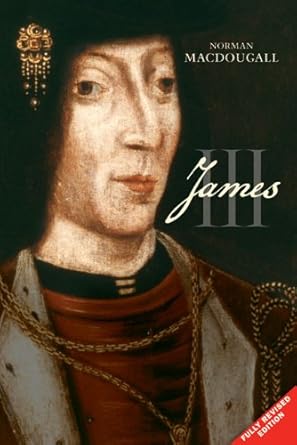
Such dialogues with the leading academics of the field were wonderful, of course.  Everything a wanna-be historical novelist could hope for, and more.  But one thing always eluded me.  You see, Norman Macdougall had written another authoritative textbook on the reign of James III.  But at the time I was carrying out the initial research for my novel, both ‘James IV’ and ‘James III’ were out of print and were already being displayed in the bargain basement shelves of the local academic bookstores.  Unfortunately, I was an out-of-work archaeologist at this time and virtually penniless.  While I successfully tracked down the biographies of James IV and James V (another Tuckwell book in the same series, though by a different author), despite searching high and low for ‘James III’, I couldn’t find it anywhere.

Through the intervening years, I’ve checked out numerous second hand book shops and looked online for copies.  The few I’ve seen have invariably been stranded in the hands of tyrannical book speculators with ridiculous price tags attached.  Like £500, or $700.  Hey, even if I had that kind of money, I wouldn’t bow to these people by giving in to their demands.  I see it as holding knowledge to ransom.  It’s immoral.  It’s outrageous.  It’s just plain wrong.

A couple of years ago, I gave up looking.  But now I’ve discovered that at long last ‘James III’ by Norman Macdougall has been reissued.  I’ve bought it, of course.  Soon this not-very-picturesque cover will be making its long-awaited appearance in my library and I can’t wait to see it!


And then there will be much weeping, wailing and gnashing of teeth, once find out just how much information and detail I’ve been missing out on in the intervening years!

Book Launch – 27th Sept 2013 – Local Author Louise Turner will be signing…

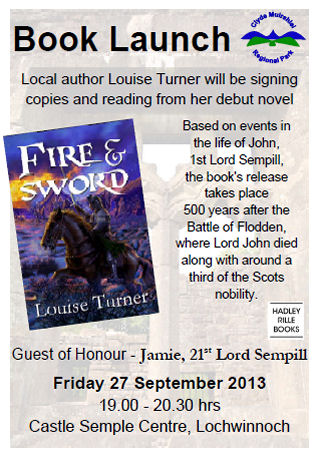
Book Launch Local author Louise Turner will be signing copies and reading from her debut novel Guest of Honour - Jamie, 21st Lord Sempill Friday 27 September 2013 19.00 - 20.30 hrs Castle Semple Centre, Lochwinnoch Based on events in the life of John, 1st Lord Sempill, the book's release takes place 500 years after the Battle of Flodden, where Lord John died along with around a third of the Scots nobility.

I’m very excited to announce that the book launch is planned!

I will be signing copies and reading from Fire and Sword on Friday 27 September 2013 – 7pm to 8:30pm.

The launch will be at the perfect venue for a book about the Sempill family   – the  Castle Semple Centre, Lochwinnoch, Renfrewshire PA12 4EA

Hope you can make it!

Picture on the left is the official poster for the event, please do feel free to share it with anyone who may be interested.

A Tale 525 Years In The Making

As I write this, it’s been exactly 525 years since a battle was fought near Stirling. A battle fought by Scots, against Scots, in which the rightful King – James the Third – died in extremely suspicious circumstances.

Unlike more celebrated battles like Culloden and Bannockburn, the Battle of Sauchieburn hasn’t captured the public imagination.  Arguably, it lacks their importance: although a king died that night, the moment of his death didn’t really mark a turning point in the country’s history.  Before and after Sauchieburn, Scotland was still a medieval country, and James the Fourth a medieval king, albeit a highly cultured one. 

But for the individuals who fought on the losing side that night, the world had fractured, perhaps irredeemably so, and it was the story of one of these individuals that I was keen to explore in the writing of Fire and Sword.

It took eight years to write the story. I had to get to know my characters, to create convincing personalities from the sparse information left behind in the historical records. This initial stage took a lot of work, but once the names had faces, a complex web of political alliances and friendships suddenly fell into place.  Finding the right voice was the next challenge, but eventually, I’d created a story I was proud of.

And then the quest for a publisher began.  That, of course, is another story.  Some bizarre events got in the way – I thought, for a long while, that my book was yet another casualty of the appalling Hurricane Katrina – but eventually, I found the perfect home for my manuscript with Hadley Rille Books.

That’s the way of writing.  It’s a tremendous struggle for years, and then all at once, everything kicks off.  The edits are done, the cover art is done, and after years in the wilderness, you can see an end in sight.  A book with your name on it.  You’ve invested so much time and so much effort, and at last, there’s something to show for it.

I’ve had lots of help along the way.  From the archaeological community, from some worthy Scottish historians, and from writers.  I am extremely grateful to the Paisley Writers Group: to Writers-in-Residence Ajay Close and Paul Houghton, who provided many insights into the craft of writing, and to my fellow writers, with Karen McKellar meriting a special mention.  And, of course, I owe a special ‘thank you’ to my editor at Hadley Rille Books, Eric Reynolds.

As for the blog…  I already have a blog at LiveJournal where I talk about life, archaeology and the numerous ancient monuments and historic buildings that I visit in my travels (see http://endlessrarities.livejournal.com/).  The focus here will be much narrower.  I’ll talk about my writing, about future projects and events.  I’ll also talk about the worlds which I explore in my work.  At the moment, this means I’ll be concentrating on late medieval Scotland, its people, its places, and its material culture.  Though in future, I’ll hopefully be moving further afield.  Much further afield…

But that’s another story!