A good few years ago, I used to write a regular blog on Live Journal, under the pseudonym ‘Endless Rarities.’
It was biased towards archaeology and heritage much of the time, because these things play such an important part in my life. And I got a lot of interest in my holiday-related posts, because they invariably veered towards All Things Archaeological and Historic Building Related, and quite often they stepped a wee bit off the beaten track.
In the intervening years, there’s been a move towards short videos and vlogs and the like, but I have no desire to yatter on at length into a camera lens. I like words. So I’ll keep writing words, and if you’re reading this blog, no doubt you like words, too, so I guess we’re evenly matched.
So, new place, same principle. Though with less images, sadly. I had to sift through all my photos and select the one image that I felt encapsulated the whoie trip – explanation below!
Just as I’m a fan of ‘slow publishing,’ so I’m a fan of ‘slow holidays.’ To quote the inimitable Guy Garvey of Elbow, ‘Just pick a point and go.’ (a line from Loneliness of the Tower Crane Driver – if you don’t know it, go check it out!) And when you get there, stay there. Wander round, examine the area with an almost forensic intensity. Get to know the landscape, the geology, the wildlife, the history, the archaeology, the built heritage.
Our ‘slow holidays’ are probably the antithesis of an ocean cruise. I don’t think I could bear an expedition that covered a vast distance but took in its destinations via a couple of bite-sized chunks. It’s just not for me. A couple of years ago, we had a flavour of something similar when we went on a marathon (sorry!) archaeological tour of Greece. It involved travelling from Athens, all the way round the Peloponnese, up to Macedonia and back over 13 days, taking in Nafplio, Mycenae, Sparta, Olympia, Delphi, Meteora and so many other interesting locations. It was a great experience, but it had the vibe of a university fieldtrip on speed. I was left feeling shattered and also slightly frustrated because we never got to know any one place properly. I did want to return to several towns for a much slower visit, so maybe that’s a victory for the Greek Tourist Board…
The Greek Odyssey was an exception. Most of the time, we follow the Guy Garvey advice. There are two prerequisites which drive our choice of destination. Firstly, there must be good walking. Coastal trails, hill walks, town walks, whatever – each has their merits. Secondly, there has to be a particular site of interest to target nearby. It could be a castle, a cathedral, a historic town. Or something prehistoric, like a hillfort, some kind of cairn, whatever. I’m very cosmopolitan in my interests.
Staying in the South Rhins of Galloway was kind of tricky because it involved more driving than I’d hoped for. We both like to dump the car for a week and walk most of the time, maybe drive a short distance. This time, it wasn’t really possible because I wanted to visit the Mull of Galloway (with lighthouse) and the nearest hotel (I don’t like self-catering, feel it doesn’t bring as much benefit to the local economy) was at Sandhead, miles away. Still, that was fairly close to my other target for the trip, which was really the main attraction, and something I’d had on my bucket list for years: the broch-like structure at Doon Castle, Ardwell Bay.
Anyway, as ever, we stumbled across much much more. In all, we got to check out the following interesting places:-
Day 1: Went for an evening walk to check out the village of Sandhead. Got a lovely view of Balgreggan Motte, a medieval motte re-used as a WWII observation post, which is just outside the village, We also got the merest glimpse (we think…) of some concrete targeting pillars of similar vintage in the bay nearby, If we’d had the chance to do the coastal walk north from Sandhead, we’d have had a better opportunity to check this out – ah, I think I feel a return trip coming on….
Day 2: Mull of Galloway lighthouse (1830, engineered by Robert Stevenson); Mull of Galloway promontory fort, comprising two rather weary and mucked about ramparts cutting off the neck of the Mull (Iron Age? Early Medieval? Possibly both….).
Day 3: Doon Castle broch, or broch-like structure, depending on the rigidity of your classification system (Iron Age, and looking rather resplendent after some consolidation work led by AOC Archaeology Ltd and assisted by local volunteers in 2024). There were salt pans at the other side of Ardwell Bay which would have been interesting, but we’d walked from Clachanmore which was quite a hoof.
The other aim of the day was to visit the Kirkmadrine Stones, which are a lovely collection of Early Medieval cross-incised stones housed at Kirkmadrine Church. The current church building is on a site which seems to have been a focus for Christian worship from a very early stage (?5th century AD or thereabouts, potentially even predating Whithorn).
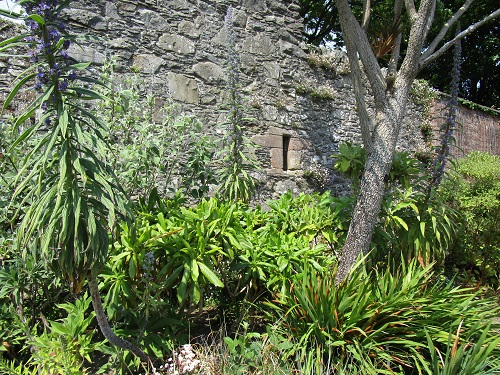
But before we got there, we added in a detour to the Logan Botanic Gardens for lunch, and there we stumbled across our Bonus Site – Castle Balzieland! It survives as a fragment of post-medieval tower-house, nestling within the boundary wall of a walled garden, where it’s obscured by giant lobelias and all sorts of other lovelies. When I first clapped eyes on it, I remarked to my hubby, ‘Is that what I think it is????’ After a bit of nosing around, when I’d clocked the speckled masonry and the all-important little rectangular window, I was certain, and it was at that point I checked the map. Bingo!!! Extra points scored for an unexpected tower-house! Finding it was one of the highlights of the holiday so it’s a view of that tiny little fragment of post-medieval walling that was selected for my featured image, surrounded by its obscuring horticultural exotica
And then it was off to Kirkmadrine to see those lovely stones….
Day 4 : Home time! But there was one last treat in store. I’d clocked a building in Sandhead that featured the legend ‘CCCS 1893.’ It looked industrial, so I’d spent the last day or so conjuring up the meaning behind the initials. I’d finally come up with ‘Cairnryan Creamery Co-operative Society.’ Its formal name, evidently, is The Old Creamery, Sandhead.
When I hopped out of the car in passing to take a photo, I started chatting with a friendly local resident, who informed me that yes, my guess was pretty much spot on. She then proceeded to talk me through the way in which the building had functioned when in use, with milk delivered at first floor level via a roadway at the rear. She also told me that the reason why a nearby street was called ‘Piggery Lane’ was because the surplus whey had been used to feed pigs at a piggery that once stood on the site. If you click the link above, it tells you all this and more – cynical friends of mine will no doubt tell me that if I bothered to use my phone, I could have found out all this myself, but I think my way’s much more fun!
Slow holidays – don’t you just love them! And that’s without mentioning all the other nice little factoids that accumulated throughout the trip. Like the discovery that the pretty little plants that didn’t quite look like scabious on the Mull were ‘goats milk vetch,’ which was a completely new one to me, and that black guillemots are called ‘tysties’ in Shetland….
Okay, there were some low points. Galloway is steadily losing its unique landscape character. The wonderful little stone-walled fields and humps of outcrop which form such a distinctive part of the countryside there are being progressively erased by large-scale industrial farming methods, and no-one can do anything to stop it. Fields are getting bigger and bigger, in a process I’ve heard described as ‘prairiefication,’ so-called because it leaves the undulating hills looking like miniature versions of the American prairies. The process is ongoing, so get to see the Rhins soon, before its original character is erased completely.
I only wish I hadn’t left it so long.