It’s been on my bucket list for years. Burnswark Hill, one of the most important Iron Age monuments in Scotland. Not only is it an Iron Age hillfort par excellence, it’s also been a hot topic for antiquarian and archaeological debate since Gordon first mapped it in the early 1700s.
I was down in Dumfries for Matters Archaeological last week. I was taking part in an event on the Iron Age and the Romans, held as part of the South West Scotland Regional Archaeological Research Framework, so it seemed like an ideal opportunity to squeeze in a field trip. The weather forecast was perfect for a long walk in the hills, though a wee bit on the warm side, so Burnswark was the obvious choice.
It’s a fascinating site. Originally, the debate ran between whether the fortifications were of Roman origin, or whether these remains were associated with the native Iron Age. The answer is more complex, because, you see, Burnswark is not just a hillfort. There’s an array of upstanding earthworks which have been progressively deciphered since the initial attempts at interpretation by Gordon and Roy. If you’re not familiar with the site, then check out this link to the Trove website, and it’ll show you the site in detail: https://www.trove.scot/image/1239704 . At the heart of the group is the defended Iron Age hilltop settlement, but there are additional fortifications lying to the north and south, flanking the base of the long sides of the hill. These are now confirmed to be Roman in date.
There’s a long history of lively discussion about the role played by Burnswark Hill in the Roman military occupation of Scotland. There are two main schools of thought. The first is that it was a training camp, used to familiarise the Roman military with siege tactics and siege warfare. This theory was based upon the conclusion that the hillfort was abandoned and its ramparts in a state of decay before the Romans ever set up shop here, The second is that Burnswark Hill saw military action at some point, though again opinions have differed as to the date and context of the operation.
When I visited Burnswark Hill last week, I had the added bonus of encountering not one, not two, but THREE different groups carrying out archaeological investigations on the site. The Universities of Glasgow and Manchester were there, as was a team from the Trimontium Trust.
The various excavations had picked up lots of lead slingshot (‘glandes‘) of various types, including a particular pierced form which whistles when airborne – an early form of psychological warfare. The remains of stone balls thrown from large mechanical catapults (‘ballistas‘) have also been found. Three circular platforms called the ‘Three Brethren,’ which form an integral part of the Roman fortifications, are likely to have been the stances where these machines were placed for the assault.
Remote sensing in recent years has suggested that the site was not in the state of decay and abandonment which had once been assumed. It was instead busy with circular roundhouse structures. It could once even have operated as a small town – kind of a ‘proto-oppida,’ Its ramparts also appear to have been more formidable than had once been surmised. This makes the siege theory lose ground to some extent. Now there’s a theory gaining traction that Burnswark Hill was attacked during the opening salvos of the Antonine re-conquest of Scotland. This – according to my friends digging with the Trimontium Trust – fits in nicely with some of the historical details. The governor in Britain at the time was one Lollius Urbicus. He ‘d led a vicious tour of duty in Judea, presiding over the infamous siege at Masada. Perhaps this had left him with a short fuse when it came to dealing with local resistance to the inevitable. Perhaps he was keen to flex his muscles as a means of reminding his political masters that he was a man who got things done. The recent excavations are revealing that the ramparts of the hillfort would have been formidable obstacles at the time, so the Roman military’s conquest of the site would not have been a cakewalk. The prodigious quantities of lead slingshot probably bear testimony to that fact.
We shall never know the full story which lurks behind the various earthworks at Burnswark, but this haunting and disturbing place certainly lived up to expectations. It was a long walk – there is a car park just below the hill, but I rightly feared it would be clogged up with the cars of the various site teams, so I opted for the long haul. It was a nice day and I needed the exercise.
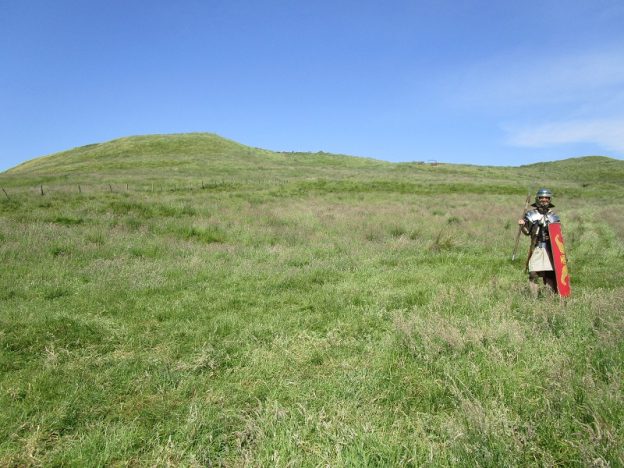
Meeting Quintus the Legionary out on manoeuvres was an added bonus. Here he is, pictured, with the hillfort to the rear. Any lumps and bumps in the foreground form part of the Roman artillery stances.
Chances are that Burnswark Hill, during the Iron Age, was a meeting-place between the various tribal units who lived and farmed in the wider area: the Brigantes, the Segovae, the Novantae and the Damnonii. That is, of course, before the Romans came swaggering in and messed everything up (I’m not a bog fan of the Romans…) When I visited last week, it struck me that with so many archaeologists and students and assorted visitors (not to mention the odd member of the Roman military….) rocking up to investigate and explore the site, it seems like its cosmopolitan air is alive and kicking….