I’m delighted to announce that Hadley Rille Books have just launched a brand new website, which features all their latest releases, including Fire and Sword.
You can find out more at:-
So follow the link and take a look!
I’m delighted to announce that Hadley Rille Books have just launched a brand new website, which features all their latest releases, including Fire and Sword.
You can find out more at:-
So follow the link and take a look!
Apologies if everything’s gone quiet round here – following all the excitement of the book launch, I promptly moved house!
Now the boxes are unpacked, I’m beavering away on the follow-up to Fire and Sword, which will hopefully be dispatched to the publisher early in 2014!
In the meantime, signed copies of Fire and Sword are available from me at a very reasonable rate. To those of you who have purchased the book, thank you! If you enjoyed it, then please, spread the word! Rate it on Amazon, or Goodreads. And please, raise awareness with the big retailers and encourage them to shelve Fire and Sword in the shops.
Over the next few weeks, I’ll be working to get the title stocked at local venues around Renfrewshire and North Ayrshire, but it’s definitely the case that I need as many people as possible to get out there and tell their friends about the book (which will soon, I believe, also be available to borrow from Lochwinnoch Library!)
Now things are settling down round here, I hope to post more often. Over the winter, I’m looking forward to introducing you to some of the places associated with James IV and his court. Places they frequented in times of peace, and war. And I’ll talk a bit more about the writing of the novel. How I created the characters, how their actions in real life influenced the way I depicted them as fictional constructs.
And of course, I’ll be keeping you abreast with news about my second novel…
Well, this it! ‘Fire & Sword’ has now achieved its official launch at the Castle Semple Visitor Centre in Lochwinnoch!
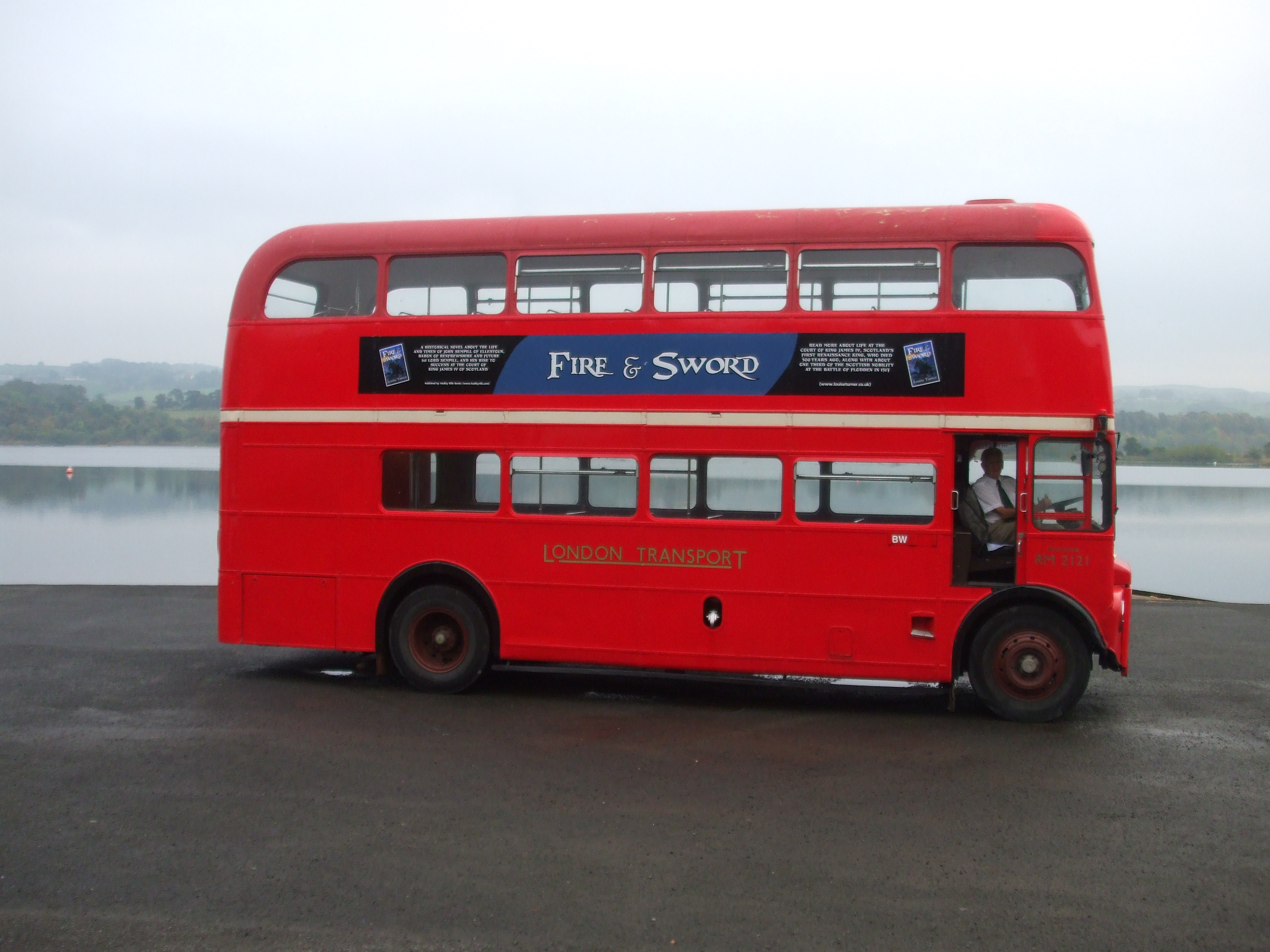
Some Unusual Publicity Courtesy of Brian Turner’s Routemaster Bus (Copyright Louise Turner 2013)
The event opened with a brief introduction by Charles Woodward, Manager of the Clyde Muirshiel Regional Park, who soon handed proceedings over to Jamie, 21st Lord Sempill.
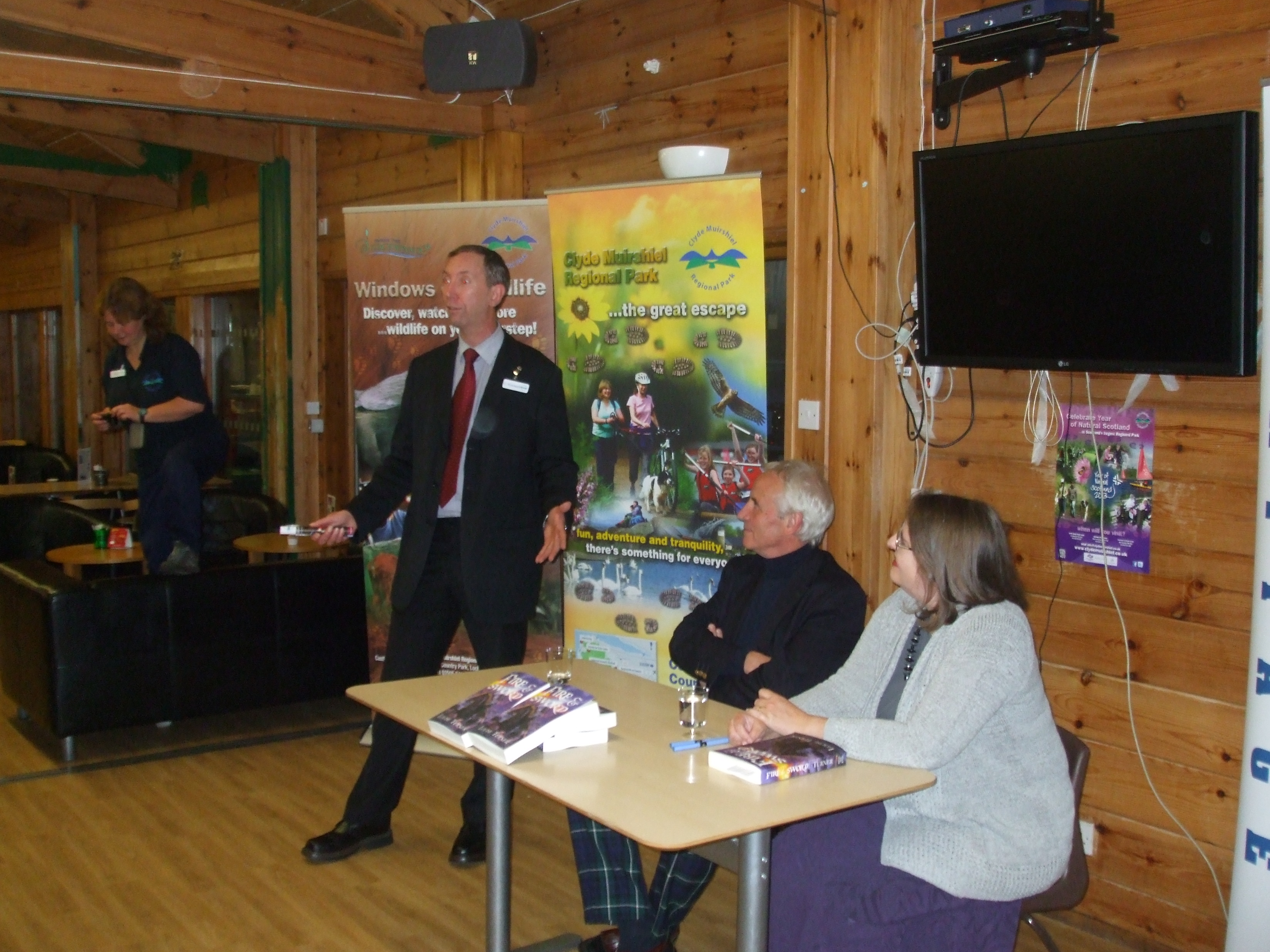
Charles Woodward, Manager of the Clyde Muirshiel Regional Park, Introduces The Evening at Castle Semple Visitor (Copyright James Dunlop 2013)
Several extracts from the novel were then read by the author, with each fictionalised episode interspersed with more detailed discussions about the real historical events which inspired the book itself, and underpinned its writing. And we took the opportunity to celebrate the life of the man whose story lies at its heart: John, 1st Lord Sempill.
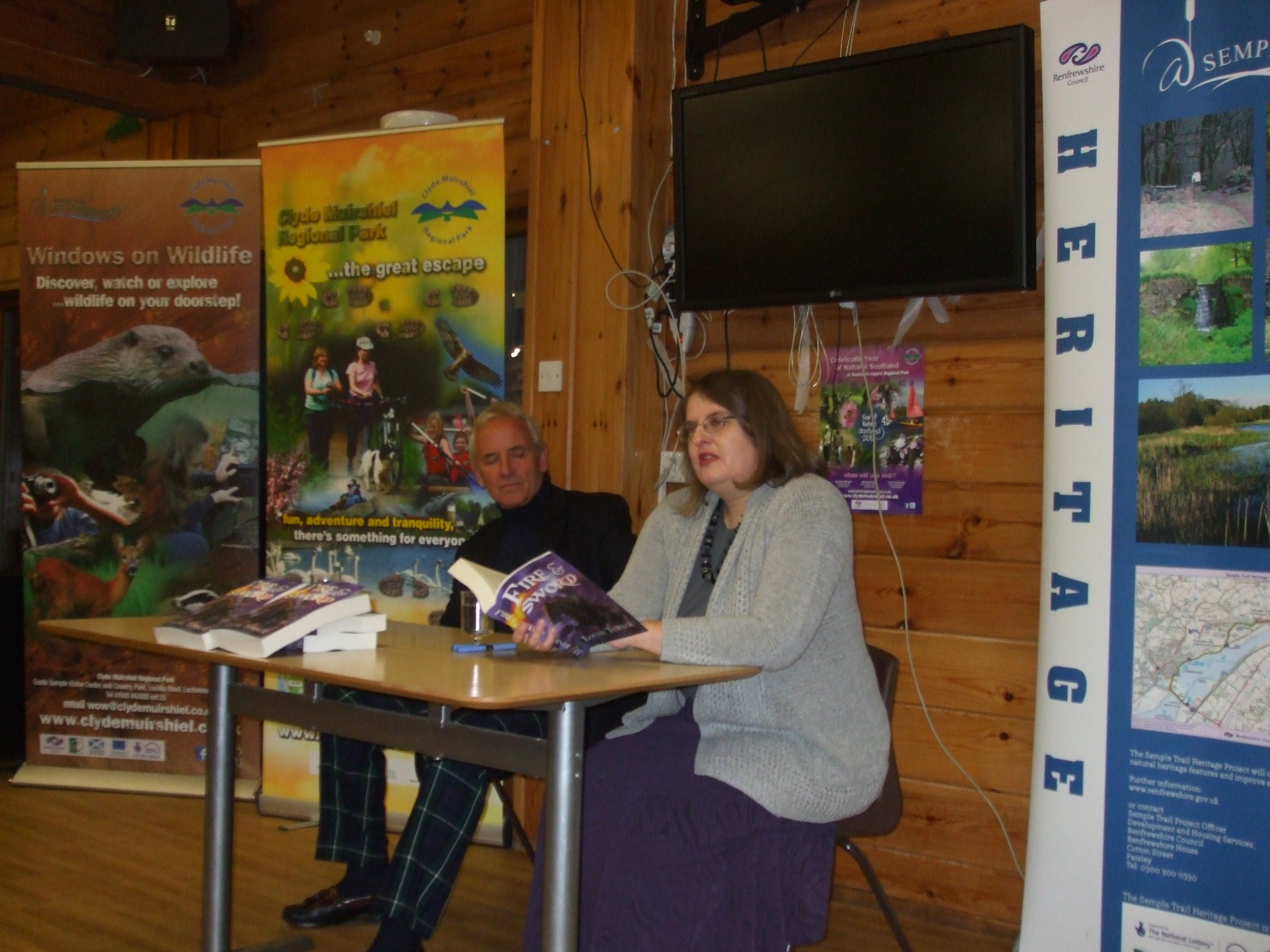
The Author Reads An Extract From the Book In The Company of Jamie, 21st Lord Sempill (Copyright James Dunlop 2013)
An invitation for questions from the audience led to a lively discussion about events which took place in the late medieval and early modern periods throughout Renfrewshire and beyond, with the final reading followed by a signing session by the author.
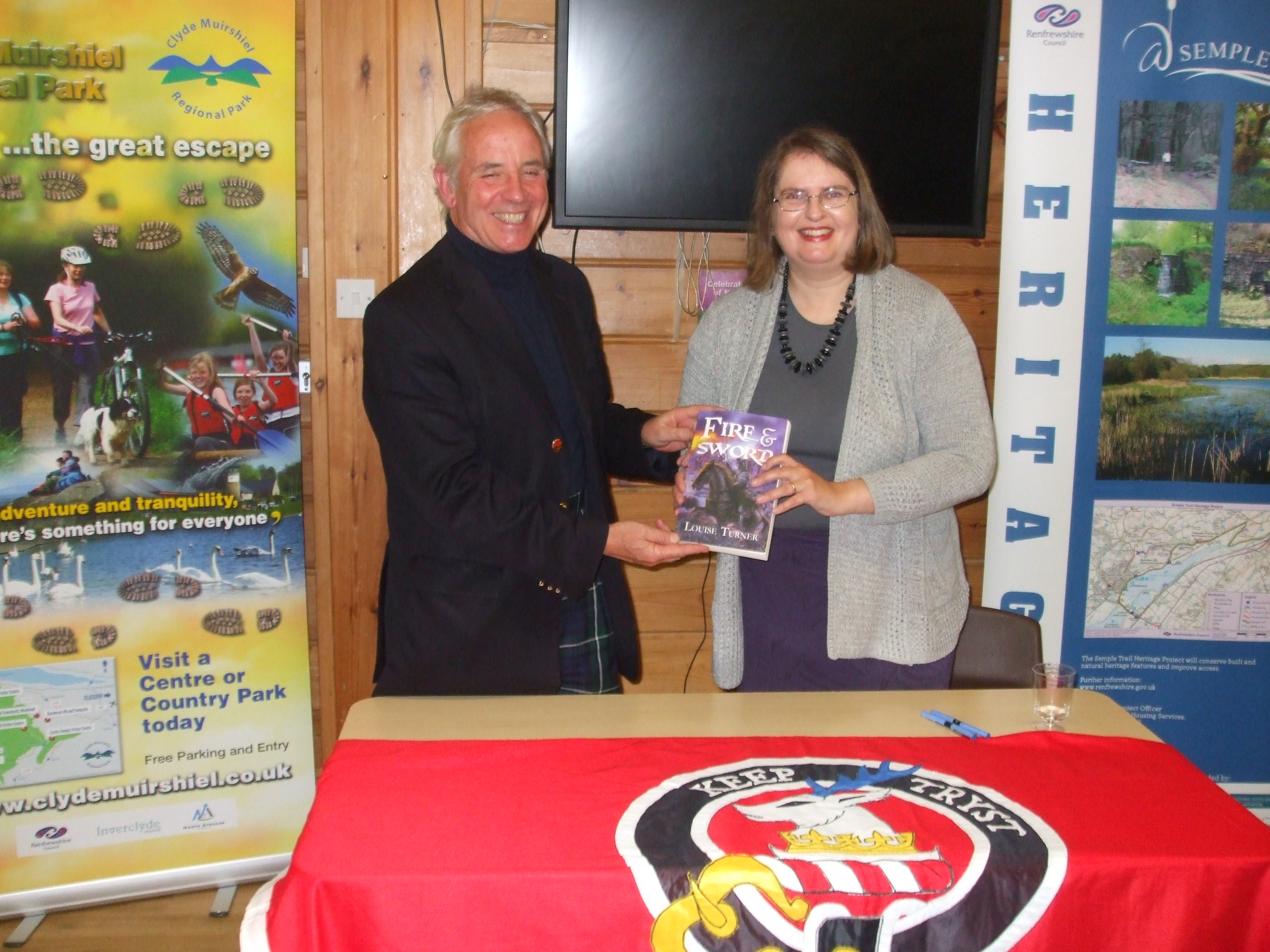
The Author, Pictured Presenting a Copy of ‘Fire & Sword’ to Jamie, 21st Lord Sempill (Copyright James Dunlop 2013)
From my own personal perspective, it was a very special night! The fictional elements were leavened with just the right amount of factual background, and what made it all the more enjoyable was the number of familiar faces who had turned out to support me: family and friends, each of whom had through the years helped urge me onwards as I faced the long uphill struggle to publication. Including Lord Jamie himself, who recounted in his introduction just how long it had been since I’d first told him about my plans to write a book around events in the life of his ancestor! From a writer’s perspective, it was equally inspiring to find attendees who had come along for the evening not because they knew me, but because they were genuinely interested in the event and they wanted to find out more about the book.
My thanks to everyone who came along for the evening and made it so memorable! A big ‘thank you’ must of course go to all the family and friends who helped with the photography, the book selling and the doling out of wine and snacks (including fellow Hadley Rille writer Harriet Goodchild. It’s a favour I hope to reciprocate once her own debut is launched in the not too distant future!).
Extra special thanks must go to Lord Jamie, of course, who was such a genial host and who gave so generously of his time to be there. And last but not least, I must acknowledge the sterling efforts of the Clyde Muirshiel Regional Council staff: Charles Woodward of Clyde Muirshiel Regional Park for hosting the event, Claire Paterson who worked so hard on the publicity side of things. And last but not least: Ann and Helen, our tireless providers of tea and biscuits for the duration of the evening. The event went on much later than expected, and yet our hosts at the Visitor Centre very patiently put up with all the crowds and the chaos, which was extremely good of them.
Now I think all that remains to be said is… Here’s to the next one!!! Let’s hope it’s sooner rather than later!
I’m delighted to report that copies of ‘Fire and Sword’ are now available for purchase on-line from Amazon.
If you’re the traditional kind of reader (like me!) then you can purchase the paperback by clicking on the link below:-
No hardback edition available as yet for the true bibliophiles amongst you, but it will be arriving soon!
And for those of you out there who no longer count yourselves amongst the Luddites, you can acquire the kindle version instead for a very reasonable price. Here’s the link:-
Enjoy – and please remember that the book launch will be taking place this coming Friday (27th September) at the Castle Semple Visitor Centre in Lochwinnoch. Entry’s free, the 21st Lord Sempill will be in attendance, there will be refreshments and nibbles available, in an evening which will feature readings from the book and a signing session. Everyone’s welcome to attend, so I hope to see you there!
And now, it’s with great delight that I give to you the first of my blog posts devoted to ongoing archaeological work on medieval sites in and around Ayrshire and Renfrewshire. And one, indeed, which features in ‘Fire and Sword’, which is an added bonus!!
On Friday 13th September and Saturday 14th September, Ardrossan Castle Heritage Society have been undertaking a series of test pits across Castle Hill in Ardrossan, under the guidance of professional archaeologists from Rathmell Archaeology Ltd.
There’s an upstanding medieval castle on the site, which still survives in pretty good nick, despite having been subject to an artillery bombardment by Cromwell’s forces in the late 17th century.
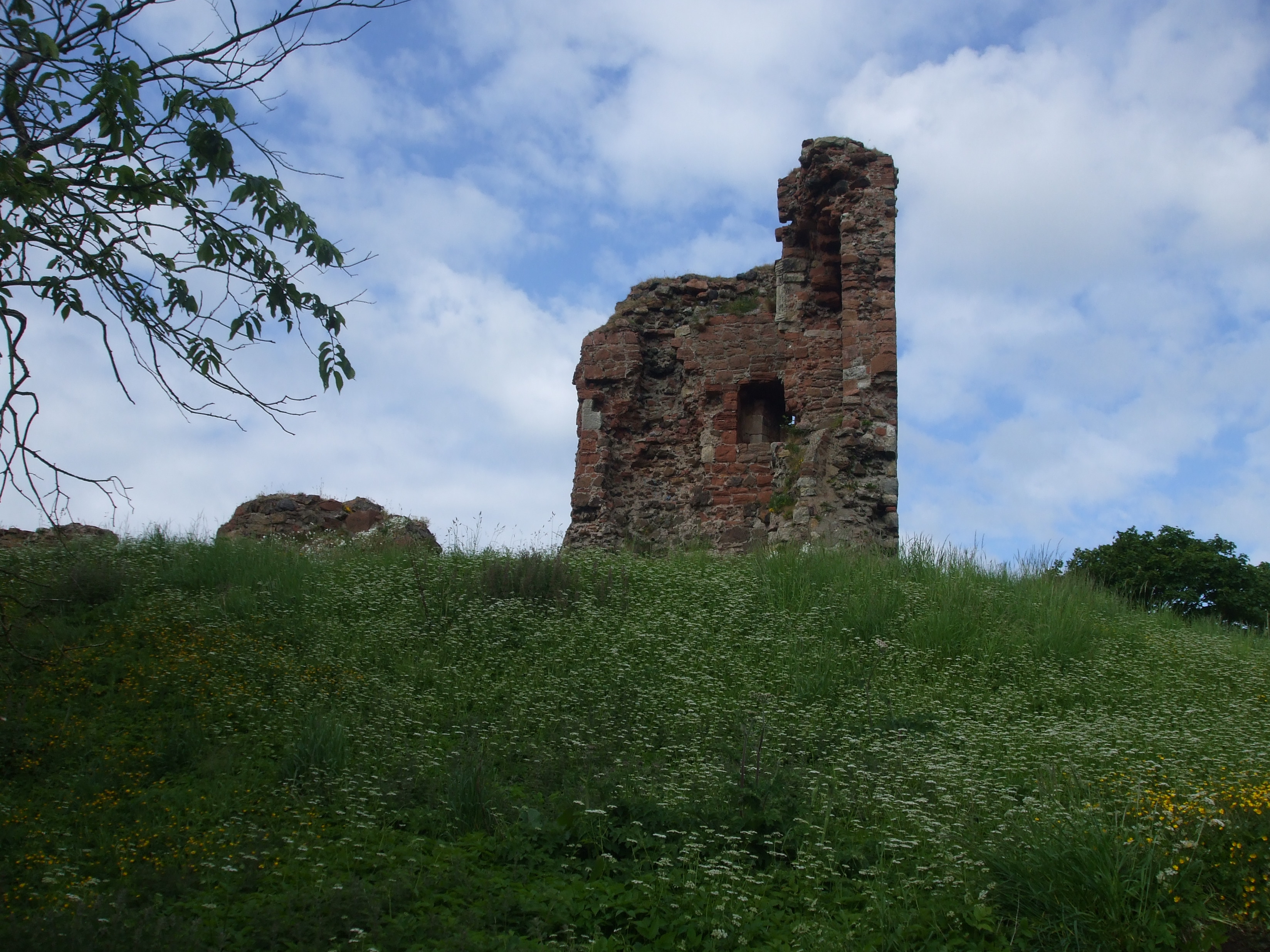
During the late medieval period, Ardrossan Castle was in the possession of the Montgomeries, and in particular, the Lords Montgomerie (Later the Earls of Eglinton). So any works on going here are of particular interest to me, as it’s a site which has a strong connection with Hugh Montgomerie (2nd Lord Montgomerie, 1st Earl of Eglinton).
The test-pitting on Castle Hill has been carried out in order to try and evaluate the archaeological potential of the wider area around the upstanding ruins of the castle, examining in particular the possibility of there being remnants of a more widespread ‘castletoun’ in the vicinity, and also the place of this relatively late structure in the longer chronological narrative of the hill’s occupation.
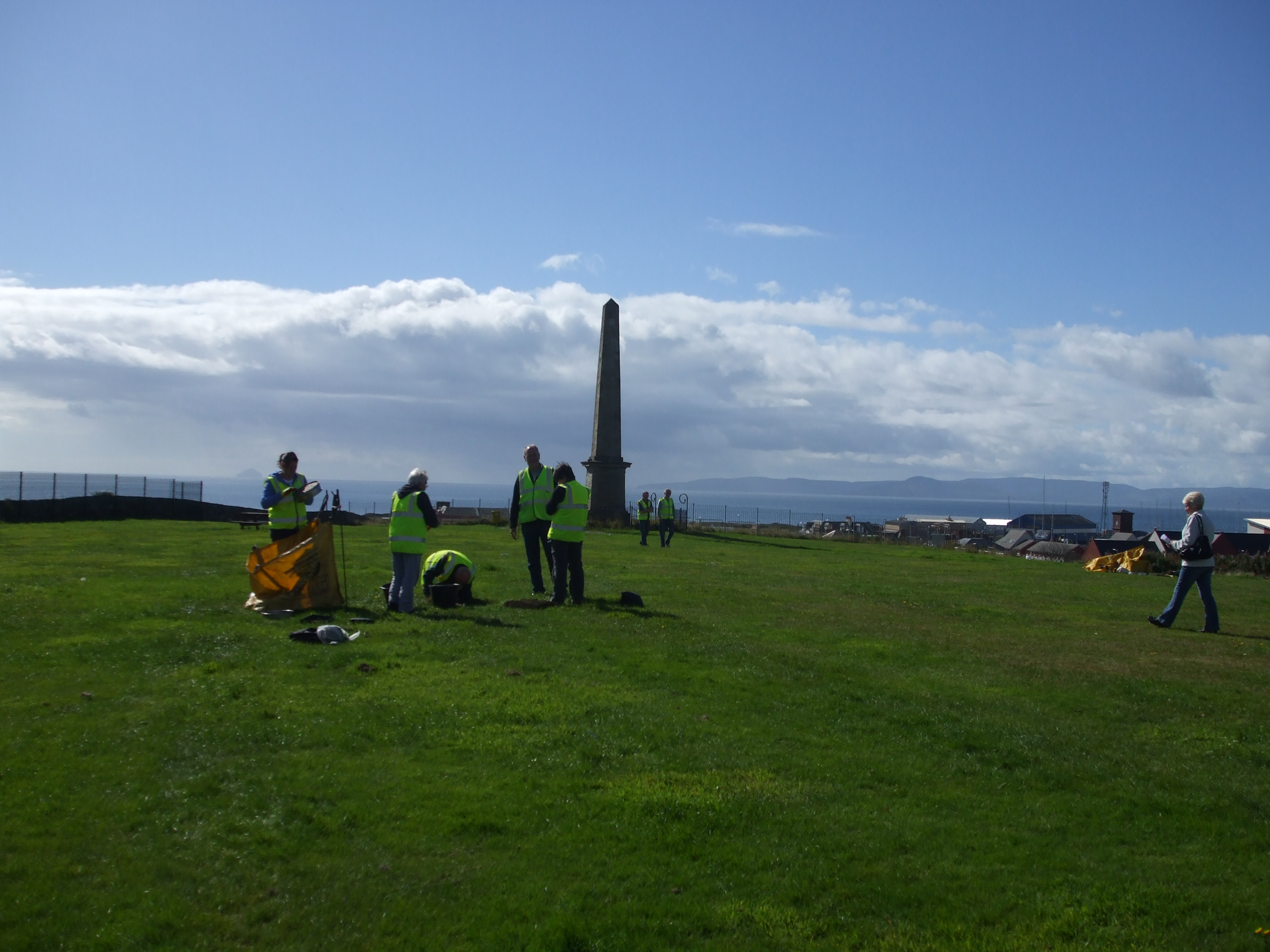
While it’s difficult to draw any clear conclusions about structural remains and archaeological features when excavations are being carried out at this kind of level (it’s a bit like carrying out keyhole surgery, when you’re working in the dark and the species that you’re operating on is unknown), what these works have clearly proven is that there is archaeological potential on this hilltop.
I’m sure the star finds will be the tiny lithic scrapers which have been uncovered here, demonstrating occupation of the hill right back into the Bronze Age and perhaps earlier. But there’s been evidence dating to the medieval period, too, like this fragment of gritty pottery:-
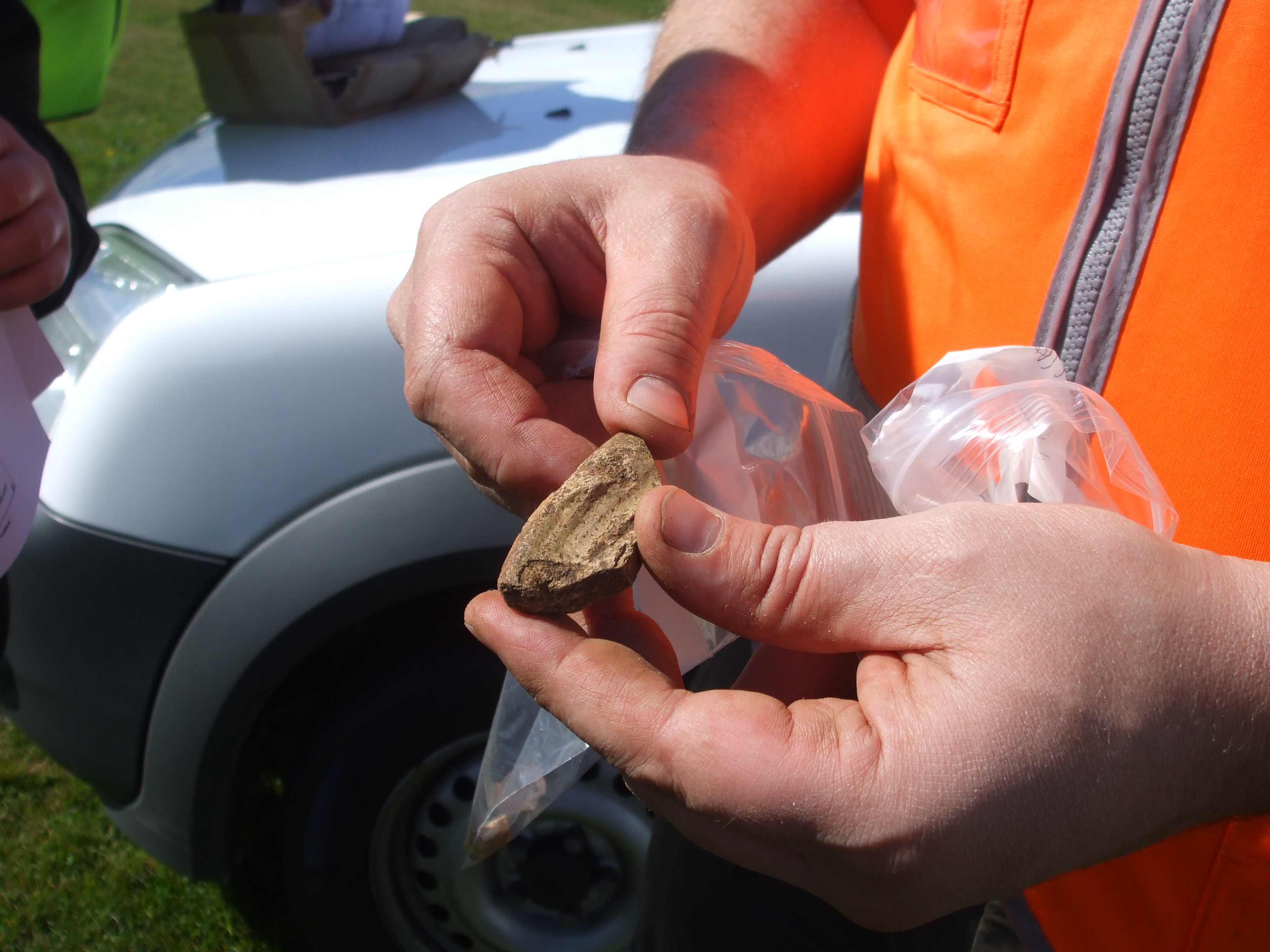
This pottery type pre-dates the events of ‘Fire and Sword’, unfortunately. But never mind, it’s still good!
What’s all the more exciting is that these initial investigations are likely to be the start of larger explorations, undertaken as part of ongoing restoration works taking place both on the castle itself, and in its wider environs. To keep up with the latest news, why not ‘like’ the Ardrossan Castle Heritage Society’s Facebook page, on https://www.facebook.com/pages/Ardrossan-Castle-Heritage-Society/375807702480483?hc_location=stream
The 500th anniversary of the Battle of Flodden hasn’t been much publicised in the Scottish media over the last couple of days. But some of us have done our best to comemmorate the occasion, and to acknowledge the sacrifice of around 14000 Scots, English and Welsh soldiers who died there. There are, in particular, a series of events currently ongoing in and around the Scottish and English borders, courtesy of the Flodden 1513 Ecomuseum, and I was lucky enough to attend a couple of them.
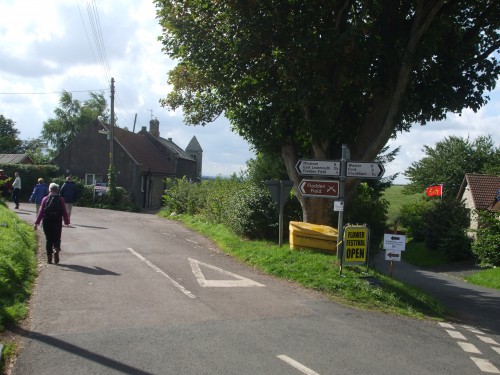
On the 9th September, I joined the battlefield walk led by the very capable Clive Hallam-Baker of ‘Remembering Flodden’. It didn’t start until 3.30pm, so in the morning I was free to extend the Flodden pilgrimage to include some of the sites connected with James IV and his fateful journey south of the border. Etal Castle was first on the agenda, before I headed to Flodden and joined the small horde that was mustering at the Flodden Monument.
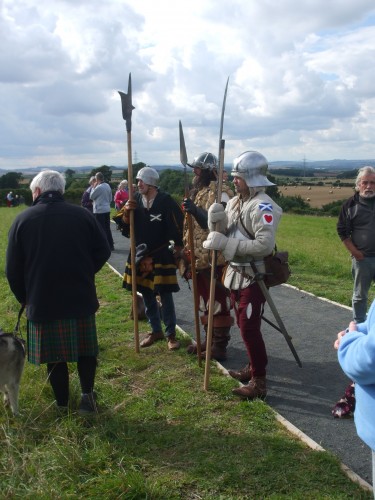
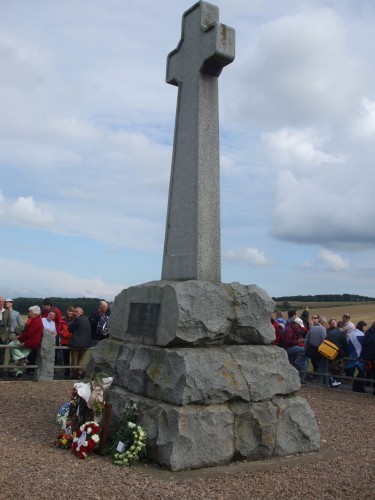
There must have been several hundred people there. All following the walk in real time on the anniversary of the date of the battle (not the actual day, there have been changes in the calender in the intervening centuries). It was a very moving experience, the mood set by a piper paying ‘Flowers of the Forest’ at the monument at 3.30pm. when the first volleys of the Scots guns actually took place.
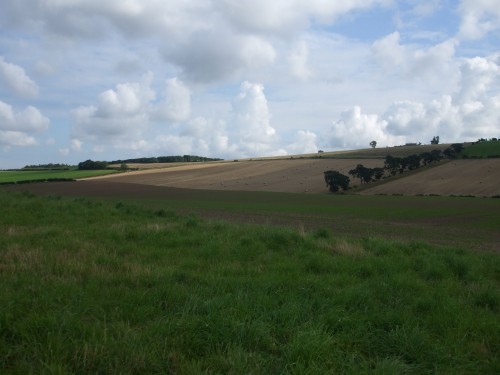
But it was the following day that proved truly special. I’d spent the morning continuing my James IV tour, calling at Swinton Old Kirk, where the death knell for the Flodden fatalities was rung once news of the defeat crossed the border, and Ladykirk, a late 15th/early 16th century church which has strong connections with James IV. But in the afternoon it was back to Branxton for a civil service commemorating the dead.
Held in a large marquee just outside Branxton village, the atmosphere at first was reminiscent of a busy county show, without the livestock. But once the commemoration service was underway, the mood was transformed. The event was arranged by a number of the local churches, and very moving and poignant it was, too.
There was no triumphalism on the part of the victors. There was no resentment on the part of the losers. Just a tangible sense of bewilderment at the futility of it all. Representatives from local communities on both sides of the border brought flags and banners to be laid there. Even the French were there. And the event itself was populated by a respectable number of clan chiefs, there on behalf of their ancestors who died there.
But the high point of the afternoon must surely have been the passionate address by Dame Judy Steel. Who spoke out eloquently on behalf of James IV, Scotland’s forgotten Renaissance king. Whose many achievements in science, the arts and education have been forgotten in the wake of his last, catastrophic defeat at Flodden.
It was a very moving experience, and one I felt priviliged to attend. It wasn’t particularly comfortable, because recent world events of course cast a long shadow, making the losses of Flodden (incurred on both sides) as relevant today as they ever were. 500 years on, the wars are still ongoing, though not unfolding so close to home, thank goodness.
I’m dedicating this post to those who fell there whose lives I have been privy to over the past decade or so. To King James IV. To John, 1st Lord Sempill. To Matthew Stewart, Earl of Lennox; Archibald Campbell, Earl of Argyll; Adam Hepburn, Earl of Bothwell; Robert Crawfurd of Kilbirnie, Sir Adam Mure of Caldwell, Sir William Colville of Ochiltree; Sir Robert Colville…
And all the countless others who fought there. The minor barons and lairds, and the men-at-arms, from Renfrew, Ayrshire and much, much further afield.
Over the last few weeks, I’ve heard many positive statements along the lines of how well Scotland coped with the disaster she suffered at Flodden. But here in the west, the loss of James IV and men like John, 1st Lord Sempill was enormous. The ensuing unrest reverberated for decades, culminating, it could be argued, in the murder of the 4th Earl of Eglinton more than half a century later.
Just one more individual tragedy, a last echo of the disaster that had made such an impact half a century before.
I’ve not long returned from the Paisley Abbey 850 Conference, and wow! Great conference! And a great venue, too!!
For the conference proceedings took place in the north transcept and the crossing of the abbey itself, which meant no excuses for nodding off and being bored, because when the attention wandered, there were all sorts of things to catch the eye. Like bundled shafts, clerestory arcades, and window tracery attributed to the fabulous John Morow…
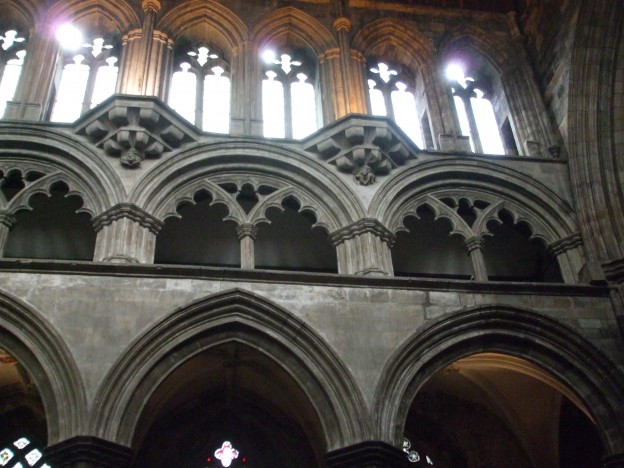
The papers proved an intriguing and diverse selection, too. I must admit that I was biased towards the morning session, where the content was veering towards the medieval. Gilbert Markus of the University of Glasgow kicked off the proceedings with a paper discussing how political allegiances can be tracked by mapping the cults of saints, considering in particular how the cult of St Brendan came to be associated with the Stewarts,
Then came Professor Richard Oram of the University of Stirling, who gave an economic overview of the colonising work of the monastic community at Paisley, and how under their encouragement areas of forest and peat carseland were drained and brought into agriculture.
Followed by Alan Steel, who provided us with a detailed snapshot of the families and personalities who settled in Renfrewshire at the time the Stewarts moved up here from Shropshire. This was especially useful for me, because it finally explained the mystery of how exactly the Montgomeries (also from Shropshire) actually came to put down roots here. Though that, I fear, must wait for another day…
And then came Tom Addyman of Simpson and Brown Architects, Buildings Archaeologist Extraordinaire, who gave us a really detailed breakdown of the complex narrative which can be glimpsed within the fabric of the Place of Paisley (the structures now standing on the site of the conventual buildings). Not much survives of the medieval buildings, but the 17th century structures have their own tale to tell which is well worthy of study.
Derek Alexander of the National Trust opened after lunch with a brisk inventory of medieval carved tombstones – including the spectacular effigies at Renfrew and Houston – and then David Roberts told us the story of Patrick Brewster, a 19th century minister at the Abbey who became notorious for his outspoken criticism of the povery that was rife in the town at this time. Lastly, the Rev. Tom Davidson Kelly talked about the restoration of the abbey in the early 20th century, undertaken first by Peter Macgregor Chalmers and subsequently completed by Robert Lorimer.
A fascinating breadth of topics, and an excellent way to spend the day! These conferences are becoming regular fixtures in Paisley, and they’re always a delight to attend. So here’s to the next one, which may take place as soon as 2014!
Hot on the heels of the ‘Flodden and the Blue Blanket’ exhibition in Edinburgh last week came another Flodden-related event in Linlithgow. I’d heard about it back in May and pencilled it in as a ‘Must Attend’ date, because it looked as if it was right up my street.
I wasn’t wrong.
The event in question was The Illustrated Book Lecture, held in Linlithgow Burgh Halls as part of the Battle of Flodden Quincentenary, in conjunction with the Linlithgow Book Festival. This featured not one, but two, authors whose recently published books have a strong Flodden connection.
The first was George Goodwin, author of a non-fiction book entitled ‘Fatal Rivalry’, which examines the run-up to the Battle of Flodden and in particular the clashing personalities of the charismatic James IV of Scotland, and his English counterpart, the bullish and inflexible Henry VIII.
The second was Rosemary Goring, whose novel ‘After Flodden’ is set in the immediate aftermath of Flodden. A short reading from the novel was followed by a fascinating interview with the author which covered a wide range of themes. It covered the author’s approach to the researching and writing of a historical novel, and also discussed the dearth of historical novels being written by contemporary Scottish writers.
Once the author showcases were over, the organisers ran an excellent audio-visual presentation about the Battle of Flodden, which visited the battlefield site and features some of the archaeological works being undertaken there. Meanwhile, the authors remained behind to sign copies of the books in the time-honoured fashion, and I’m delighted to report that both titles sold quite briskly.
Unfortunately, I couldn’t take advantage of the special offer prices for Rosemary Goring’s novel, as I’d bought it previously from Waterstones, but I did manage to smuggle my copy in for signing! I was also delighted to have an excuse to get hold of a copy of ‘Fatal Rivalry’, which I’d put on my ‘Must Buy!!!’ list just as soon as I heard about its publication.
So a big ‘thank you’ to Nick Davis of the Flodden EcoMuseum for circulating news of this event so widely. I think the girl at the door was quite nonplussed when she realised that two of her visitors lived so far away that their postcode wasn’t even held on the computer system, but hopefully it’ll help reinforce Linlithgow’s identity as a ‘heritage burgh’, with an impressive heritage resource that is well worth celebrating and exploring further.
I believe Rosemary Goring will be appearing at various Borders Book Festivals throughout September, so do keep an eye open both for her, and her book!
A big ‘thank you’ to all the local cafes, businesses, libraries, community centres, arts centres (amongst others) throughout Renfrewshire, North Ayrshire and Inverclyde who have put up posters advertising the forthcoming book launch. It’s great to see them popping up in all sorts of locations – Tom Vandenberg’s stunning cover art really catches the eye!
And, of course, an extra special ‘thank you’ to the staff at Clyde Muirshiel Regional Park, and to the tireless Claire Paterson in particular. Their support and enthusiasm throughout has been fantastic!
This weekend I was in Edinburgh, catching a few shows at the Festival and stumbling across interesting exhibitions in unexpected places…
What caught my eye in particular was an exhibition entitled ‘Flodden and the Blue Blanket,’ hosted by the Convenery of Trades of Edinburgh. With the 500th anniverary of the Battle of Flodden fast approaching, it seems an appropriate choice of subject matter, since this ancient institution has in its keeping a treasured artefact which has strong links with Flodden and James IV. This is the ancient Trades Banner, more commonly known as the ‘Blue Blanket’.
Hanging in a modern display case which provides a sympathetic environment suitable for the object’s long-term survival, the ‘Blue Blanket’ in question is a mere stripling, dating back to the late 17th century. But it faithfully reproduces a much older banner, thought to have its origins in the early 1480s, when it was presented to the city by King James III and Queen Margaret.
Legend has it that the banner was subsequently carried at Flodden by Edinburgh’s contingent of soldiers, and that following the disastrous Scots defeat, it was plucked from the battlefield and carried home by one of the few survivors of the Scots forces.
Though centred upon the banner, the exhibition looks in depth at the events leading up to Flodden itself and to the impact this catastrophic event had for the City of Edinburgh in the years that followed. It also examines the way in which Flodden has been immortalised in myth and literature, as well as art, with a prominent place being given to this dramatic painting by William Brassey Hole, which forms part of the City of Edinburgh collections:-

It’s a fascinating exhibition and well worth a visit. But you’d better be quick, because it’ll be coming to an end next Saturday (31st August). The venue is at the Trades Maiden Hospital, 61 Melville Street in Edinburgh. Entry is free, with opening hours between 10am and 5pm.
For more details, check out the link below:-
http://www.edinburgh-trades.org/index.php?option=com_content&view=article&id=192&Itemid=229